JavaScript disabled or chat unavailable.

Have a question?

We have answers!
Chat Monday-Friday, 8 AM - 5 PM (except MS state holidays)
Phone: 601-432-4492 or Toll free: 1-877-KWIK-REF (1-877-594-5733)
Text: 601-208-0868
Email: mlcref@mlc.lib.ms.us

Friday, March 21, 2014

Book of the Day: Bottle Trees...and the Whimsical Art of Garden Glass

In celebration of the second day of Spring, our Book of the Day is Bottle Trees...and the Whimsical Art of Garden Glass. The author of this wonderful little book is Mississippi's own acclaimed horticulturalist, garden writer, photographer, and host of MPB's The Gestalt Gardener, Felder Rushing. Felder takes readers across America and England (and our very own Mississippi!) with fantastic pictures illustrating the bottle tree phenomenon. Not only does Felder reflect on his own personal history with bottle trees in this book, but on the historical (and superstitious) significance of these works of yard art!

Come and visit us at the Mississippi Library Commission to check out this neat book, or get suggestions for other books by Mississippians!


http://www.felderrushing.net/
http://mpbonline.org/gestaltgardener/

Friday, March 14, 2014

3.14 Nuggets About Pie

Many years ago, my former in-laws, sweethearts though they were, trapped me in their mini-van for four hours so that I could experience the wonders of Pie Town, New Mexico. All I have to say about that four-hour road trip nearly twenty years later is this: Y'all, there was no pie. (I learned later that, in order to find pie, you have to show up in September.) In the hopes of making your Pi Day experience more pie-like, and to make up for decided lack of pie in my life, I give you 3.14 nuggets about pie:

1. I remember reading about Stargazy Pie in some book or other way back when. This delightfully macabre dish, which hails from Cornwall, England, consists of "pilchards baked in a pie with their heads poking through the crust" (Star). Now, for some reason, I always thought a pilchard was a type of bird, so I have always pictured either little bald bird heads (eek!) or still-feathered bird heads wafting bird feathers all in my pie (much worse!) Imagine my relief when I took the time to do some research and found that pilchards are, in fact, sardines:

Stargazy Pie,
with each pilchard gazing toward the stars

In my mind, this is much better than, say, mockingbird pie or bluebird pie. The unique arrangement of this pie allows the oil of the fish to drain back to the crust, making it more moist and delicious (greatbritishkitchen).

2. Have you ever heard someone refer to eating humble pie? I mean the turn of phrase, here, not the British rock band. It seems that this phrase used to mean something different than its current meaning, which is "to act submissively while admitting an error". Once upon a time, the word numbles started appearing in the English language. Numbles are all the yummy bits of meat from an animal carcass: the entrails, the heart, the liver, etc... The word gradually became umble, and then humble, where it began to pick up the "humble pie" connotation we all know.
Another kind of Humble Pie

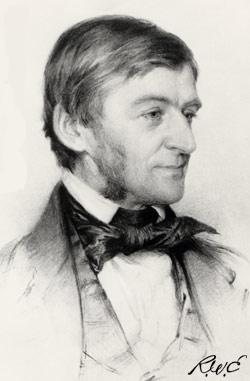
3.  The Transcendentalist writer and poet Ralph Waldo Emerson was a huge fan of pie. According to Oliver Wendell Holmes, "Emerson's mode of living was very simple: coffee in the morning, tea in the evening... but always pie at breakfast" (Holmes 362). Once, he was preparing to eat his morning meal with some acquaintances and offered them each in turn a large wedge of pie. When each one declined, Emerson said, in complete frustration, "But, Mr. So-and-so, what is pie for?" (Holmes 269). I'm with you, Emereson. Pie for breakfast each morning does sound divine.
Ralph Waldo Emerson,
Pie Lover

.14 Not to be outdone, Jane Austen was also a pie devotee. The British author once wrote, "Good apple pies are a considerable part of our domestic happiness." (Schulz 13).

I'm quite hungry now, after all this talk of pie, and I wasn't lucky enough to have pie for breakfast. Pie for lunch sounds divine as well!

Holmes, Oliver Wendell. American Men of Letters: Ralph Waldo Emerson. Boston, MA: Houghton Mifflin Company, 1886. eBook.
http://commons.wikimedia.org/wiki/File:Baked_stargazy_pie.jpg
http://commons.wikimedia.org/wiki/File:Humble_Pie_1974.JPG
http://commons.wikimedia.org/wiki/File:RWEmerson2.jpg
http://www.greatbritishkitchen.co.uk/recipebook/index.php?option=com_rapidrecipe&page=viewrecipe&recipe_id=1015
Star. (2012). In Brewer's dictionary of phrase and fable. Retrieved from http://search.credoreference.com/content/entry/brewerphrase/star/0
Schulz, Phillip Stephen. As American as Apple Pie. New York, NY: Simon and Schuster, 1990. Print.
Soukhanov, Anne, ed. Word Mysteries and Histories: From Quiche to Humble Pie. Boston, MA: Houghton Mifflin Company, 1986. Print.


Friday, March 7, 2014

Charlie and Minnie

I was recently doing some research in the Simpson County News from March 18, 1909 and found this little blurb out of Maben, MS.

The quality isn't the greatest because of the age, but it says the following:


"Charlie Crossin, a 14-year-old boy wearing knee pants, and Miss Minnie Corley, 30 years old, were married at Maben. The boy's parents, hearing of the marriage, separated the couple within an hour and refused to allow the boy to return to his new wife."


While I wasn't able to find any more information on Charlie, I did find a Minnie Corley (her age is given as two years younger than the Minnie mentioned in the article) from Mississippi who moved to Texas, married at some point between 1910 and 1920, and had 3-4 children. Is this our Minnie? It's hard to know with the small amount of information given in the article above, but I like to think so.

Friday, February 28, 2014

Pratt-Smoot Act Day

Every March 3rd here at the Department of the Blind and Physically Handicapped Library Service,we celebrate the Pratt-Smoot Act. The Pratt-Smoot Act essentially gave talking books their start for the blind.
Ray Foushee, speaker at Pratt-Smoot Day, 2013
Narrator from American Printing House
On March 3, 1931, President Hoover signed it into law “An Act to provide books for the adult blind,” also known as the “Pratt-Smoot Act” after its sponsors Representative Ruth Pratt and Senator Reed Smoot. This Act authorized an annual appropriation of $100,000 under the direction of the Librarian of Congress, for a national library service to provide books for use by adult blind residents of the United States. The Pratt-Smoot Act also permitted the Librarian of Congress to “arrange with such libraries as he may judge appropriate to serve as local or regional centers for the circulation of such books, under such conditions and regulations as he may prescribe” and to give preference at all times “to the needs of blind persons who have been honorably discharged from the United States military or naval service.” Following the passage of the Pratt-Smoot Act, the Library of Congress established the “Books for the Adult Blind” project, which began operating on July 1, 1931. Now the National Library Services for the Blind and Physically Handicapped serves anyone with a visual impairment, physical impairment, or an organic reading disability. For more information: http://www.loc.gov/nls/eligible.html.
Pratt-Smoot Act Celebration
at the Mississippi Library Commission, 2013

Friday, February 21, 2014

What's On Your Bookshelf, Roosevelt?

We recently came across a charming, small book in our collection titled Dr. Johnson's Doorknob and Other Significant Parts of Great Men's Houses by Liz Workman. We were certainly not disappointed when we saw that the table of contents included "Great Men's Books"! Readers get a peek at the bookshelves of greats such as Thomas Cole, Washington Irving, Sir Winston Churchill, and Thomas Jefferson. The close-up of Franklin Delano Roosevelt's books, in particular, caught our eye. We could literally browse a snippet of his reading selections. Of course we had to share!


  • The Key by Patricia Wentworth 
  • There Shall Be No Night by Robert E. Sherwood 
  • The Workers at War by Frank Julian Warne
  • American Planning and Civic Annual 
  • New Frontiers of the Mind: The Story of the Duke Experiments by J.B. Rhine
  • The Bundle of Life by Jane Revere Burke
  • New Year's Day by Edith Wharton
  • The Old Maid by Edith Wharton
  • The Spark by Edith Wharton
  • Response by Mary Pownall Bromet

So, what's on your bookshelf? Need suggestions? Contact us or stop by our building to browse our shelves!


Workman, Liz. Dr. Johnson's Doorknob and Other Significant Parts of Great Men's Houses. Rizzoli International Publications, Inc. NY 2007. Print
www.goodreads.com
www.amazon.com

Friday, February 14, 2014

Love, Mississippi Style

Love is a strange beast. Our human hearts are both fickle and steadfast at the same time, draped in a gauze of romance. Mississippi authors are no exception to the highs and lows of love--why would they be? When two hearts begin to talk to one another, the idea that they'll ever stop is absurd. Here are two of those beginnings.

Richard Wright and Ellen Poplar (Poplowitz)


Richard Wright met Ellen Poplar (Poplowitz) about 1939. Of their first outing together, Ellen later said:

We talked for hours. We had a wonderful time. We sat on a bench and talked. There was an instant understanding between us.
Richard proposed to Ellen almost immediately, within a few weeks of their meeting. She, though, was a practical woman and wanted to be certain that they truly loved one another. After much soul-searching, Ellen decided that their love was pure and tried to meet Richard. Surprisingly, he had already proposed to another woman, a former fling, and he married her instead. Ellen was heartbroken. (Some say that Richard claimed he married Dhimah Meadman to spite Ellen. Ah, the things we do for love.) The marriage lasted less than a year. Upon Richard and Ellen's reunion:

He heard her voice and came onto the landing at the top of the stairs and called her name. "It was a really eerie thing," she says. "I knew immediately that my family counted for nothing... I was very excited and we fell into each other's arms and there was no talking after that. The whole thing was settled... I just moved in with Dick right in that house."
Medgar Evers and Myrlie Beasley


Medgar Evers met Myrlie Beasley on her first day of classes in 1950 at Alcorn in Lorman, Mississippi. They fell in love. Myrlie remembers his proposal of a little over a year later,

I couldn't speak. Medgar took the ring from the box and put it on my finger. I watched as though I were watching someone else. "I'm sorry I can't afford a more expensive ring, Myrlie," he said softly. "This is the best I can do. But along with it goes all the love I have."
I have never felt quite like I did at that moment.
Although these two marriages traveled very separate paths, the meeting of souls, the mysterious bonding of two hearts, is the same. Love is a hard road to travel, but it does, indeed, seem to make the world go round.

Want to explore the (love) lives of Mississippi authors? Our biography section is sure to warm the heart of any book lover. Come on in!

Evers, Myrlie. For Us, The Living. Garden City, NY: Doubleday and Company, Inc., 1967. Print.
Rowley, Hazel. Richard Wright: The Life and Times. New York: Henry Holt and Co, 2001. Print.

http://ecuip.lib.uchicago.edu/diglib/language/blackboy/gallery/index.html
http://www.jacksonadvocateonline.com/?p=3192

Monday, January 27, 2014

Jacks: You've Got To Be Nimble

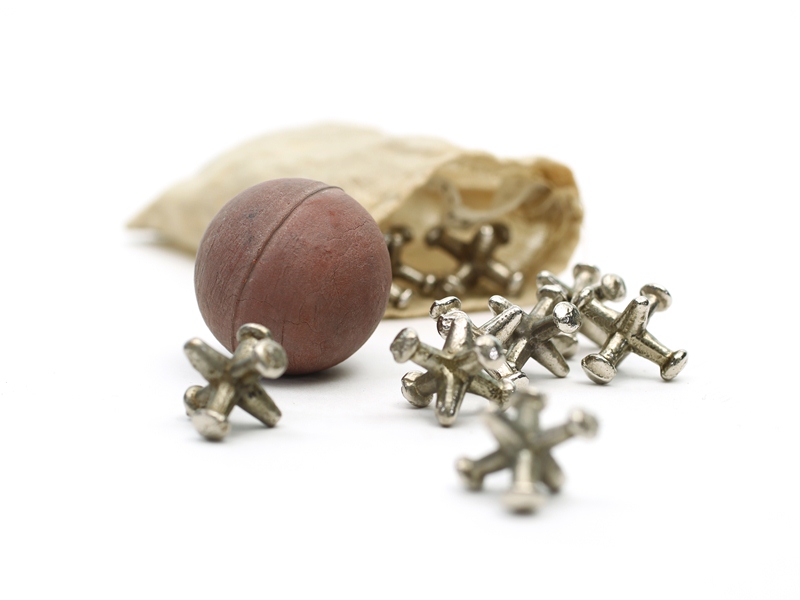
Jacks
A few days ago, someone asked if the old-fashioned jacks with which we played as children were still being made and sold. "You remember those, right? We used to play with them back in the day." Oh, yes, we most definitely remember them, and yes, jacks are still around. In fact, it's pretty amazing how long the game of jacks has been around. Some claim that the Roman god Hermes invented the game. He liked to play a few rounds with his half-brother/mentor Apollo (Bloomsbury).

Jacks has had several different names over the years. Some have called it knucklestones, doing so because jacks originally came from sheep knuckles and other various small bones. Checkstones and jackstones were two other popular names; checkstones is a similar game played with small pebbles, or checks (Collins).

Some of the best things about the game of Jacks, in our opinion, are its complete versatility and ease of play. It can be played by one person or a group. To play, one follows these simple steps:
  • Scatter the jacks
  • Throw the ball in the air
  • Pick up one jack with the same hand
  • Catch the ball with the same hand after it has bounced once
  • Repeat until all the jacks have been picked up
  • Graduate to a new round by picking up the jacks in groups of twos, then threes, etc... (Diagram)
We checked www.amazon.com and found a plethora of jacks for sale. They're also available at many toy stores and drugstores. Have fun playing, and enjoy your blast to the past!

http://commons.wikimedia.org/wiki/File:The_Childrens_Museum_of_Indianapolis_-_Jacks.jpg 
Hermes. (1996). In Bloomsbury dictionary of myth. Retrieved from http://search.credoreference.com/content/entry/bloommyth/hermes/0
Jacks. (2000). In Collins english dictionary. Retrieved from http://search.credoreference.com/content/entry/hcengdict/jacks/0
The Diagram Group. Family Fun and Games. New York: Sterling Publishing Company, 1992. Print.
Related Posts Plugin for WordPress, Blogger...