JavaScript disabled or chat unavailable.

Have a question?

We have answers!
Chat Monday-Friday, 8 AM - 5 PM (except MS state holidays)
Phone: 601-432-4492 or Toll free: 1-877-KWIK-REF (1-877-594-5733)
Text: 601-208-0868
Email: mlcref@mlc.lib.ms.us

Monday, October 25, 2021

Horror and Hope

Sebastian Murdoch
Readers Advisor, Talking Book Services


Growing up, friends and family might have referred to me as “a little odd.” I was a daydreamer, perpetually lost in fantastical worlds of my own creation, imagining for my toys lives and adventures of their own while I was at school or away on a family vacation. I was also inexplicably drawn to the strange and surreal, to the twisty, often scary, corners of the world around me. In those corners, I didn’t see dust and cracks in the paint, but the ashes of a hastily-smothered fire or hidden messages that only I could read. I was, to put it simply, a weird kid.

I was also, first and foremost, a reader. From the time I could string words together in a coherent sentence, I gravitated toward books and words, toward stories. My mother tells an anecdote in which, at about six or seven, I described myself as “loquacious.” Though I was right in my choice of self-identification, I imagine that I chose the word not because it fit me and my personality, but because I enjoyed the way it sounded, the languorous rise and fall of the syllables, the way it drew my lips forward, then back, then forward again as I shaped them around each sound. The fact that I just used 59 words to describe the reason for choosing that word goes to show that I am much the same now as I was then.

Another thing that has not changed for me since I was a child is my fascination with the horror genre. Throughout elementary school, I devoured the Goosebumps series by R.L. Stine, even going so far as to fill out a form in the back of one of the books to join his fan club. I mailed the application and was rewarded with a signed photo of the author himself. Granted, that signature may have been a copy printed onto each of the photos sent to us ravenous children, but it still meant something to me. That photo is long gone now, misplaced or discarded during one move or another, but I remember it vividly, as I also do the stories Stine wrote. They, along with but to a lesser extent the Fear Street tales, have stuck with me into adulthood, where I now write my own horror stories professionally, as an agented writer looking toward the publication of their debut novel. While my own work does not center around children or teenagers, the core appeal of those spooky stories sits at the head of my practice, my process of crafting a narrative meant to fascinate and simultaneously repulse its reader.

Because that’s the central tenet of good horror writing, isn’t it? To make the reader scared to turn the page, but helpless in the face of their own curiosity, their need to follow the story through to the end, because it’s just that good. I think that’s something about horror that translates well to real life: so many of us are scared of how our stories will turn out, and yet most of us go through our days anyway, wanting to know how it all shakes out. It makes sense that we might be propelled through a fictional story by that same curiosity.

All this to say, I completely understand the people who eschew horror because they have lived through enough terror and pain to last them the rest of their lifetime. If you have experienced real, palpable fear that leaves behind a psychic (and, in some cases, physical) scar, then why subject yourself to that same kind of fear in your leisure time? It makes a certain kind of sense. But, on the other hand, some of those same people who have experienced trauma and fear in their real life will often find fictional horror a type of outlet or catharsis for their pain. Because they are able to control the type of fear to which they’re subjected, the fear becomes less damaging and more of a purge of the emotions that are wrapped up in fear: grief, embarrassment, guilt. If we fear the pain of grief, for instance, then might it not be helpful to run through a fictional situation in which loss plays a large role, as a sort of trial run? Would we not then be better prepared for the emotions that arise when we are in the midst of a divorce or dealing with the death of a loved one or mourning the loss of a home or a part of our lives we thought would be around forever? Of course, it’s not a foolproof strategy for how to cope with unpleasant emotions, but nothing is really.

In my case, I fear physical pain to an extreme degree. (Please disregard the fact that I have multiple tattoos; I’m talking about a more intense and ongoing pain here.) I avoid most situations in which an amount of pain might be expected. You will not catch me scaling cliffs or subjecting myself to a session of CrossFit. Scenes wherein tremendous amounts of pain are inflicted on the characters cause me to cringe and duck behind my hands. I have nightmares about body horror like Junji Ito’s The Enigma of Amigara Fault. But I have also watched almost all of the Saw movies and have listened to the audiobook of Nick Cutter’s The Troop and The Deep multiple times. I don’t know if consuming these kinds of horror stories will make it easier if I ever go through something truly painful (like when I fractured my wrist as a child), but it certainly makes me feel more grateful for the times when my body feels healthy and strong.

That’s another thing that drives horror: a fear of weakness. I would be willing to bet that most people have experienced a nightmare in which they felt completely helpless, whether that meant being unable to walk or run from a pursuer or a sudden muteness that left them incapable of calling for help. We all fear being weak in some way—physically, emotionally, or mentally—and at the core of that fear is the question, “What will be done to me when I am unable to defend myself?”

This question is especially pertinent to those of us who live with some form or marginalization. Someone with a mental illness or disability may fear an abusive conservatorship (wherein another person is put in charge of your life, as in the case of Britney Spears’s conservatorship) or institutionalization. Someone with a physical disability that literally prevents them from being able to defend themselves would have ample cause to fear an abusive caregiver or any callous stranger on the street. And, on a slightly more philosophical but no less important note, a person of color or a queer person might fear violence when they lack a support network, which might be considered a way to defend yourself against social attacks or manipulation. That’s all to say that, regardless of your placement in the social hierarchy of the West (as that is where I have lived all my life and so can only speak to my experiences here), everyone will have seen or experienced what can happen when one person is at a disadvantage to another. It’s similar to love or intimacy in a way. We are all always asking, “If I show you this vulnerable part of myself, will you be good to me?”

It’s the same for me with my writing. I put so much of my heart into my work that sharing it with another person is akin to tipping back my head and exposing my throat. They could kiss it, or they could cut it. It all depends on them at that point. And, even in spite of that fear, I still show my stories to other people. Why? Why not hide it, and thus that soft part of me, away where it can’t be harmed? Because otherwise I will have missed out on that intimacy, that connection with another person. Yes, the fear is there because I have been hurt in the past, because I know that I could be hurt again, but so too is the knowledge that hope exists. Any good horror story will maintain that spark of hope, because it isn’t just the curiosity that drives us to finish the book—it’s also the hope that, despite all that terror, things will be okay in the end. That’s why people get into relationships again even after a bad breakup or why people ride roller coasters again and again. Because the risk is worth the reward we hope awaits us. And all that fear we experienced along the way?

Well, it just makes us more grateful.

Monday, October 18, 2021

Come Library With Us!

The Mississippi Library Commission is hiring! Several beloved staff recently left for positions at other libraries and agencies. While we celebrate the new paths in their careers, we also can't wait to meet the people who will fill their shoes in the months to come. 

We're located at the Research and Development Center in Jackson, Mississippi, just off Lakeland Drive and Ridgewood Road. Our award-winning facility is the home to the Mississippi Center for the Book, a Patent and Trademark Resource Center, and the Mississippi Talking Book Service for the Blind and Print Disabled. We also offer extensive reference and interlibrary loan services for Mississippians and library consulting services, digital services, and network services for libraries and librarians across the state. Our current openings include:

If you are interested in joining our team, please submit an application to the Mississippi State Personnel Board. Please keep an eye out in the coming weeks for additional openings at our agency.

Thursday, September 16, 2021

A Letter from Your Friendly MLC Archivist

Miranda Vaughn
Reference/Archives Librarian

Dear Reader,

While organizing the MLC archives, I’ve come across a number of letters, reports, etc. regarding programs and services the Library Commission has offered over the years. Some of these were standard library services, while others were quirky and creative. Since September is Library Card Sign Up Month (and since those magical library cards get you all kinds of amazing FREE services), I thought it would be appropriate to share a few of the programs and services MLC has offered over the years.

Throughout MLC’s history, we have collaborated with other organizations in the state to provide programs and services to library patrons across Mississippi. Beginning in the 1950s, the Library Commission offered training and resources to Mississippi’s Choctaw schools. MLC also assisted the Choctaw Indian Agency in setting up a bookmobile, pictured below. 

Mississippi Library News, September 1963

Thank you letter from Pearl River Indian School student

Thank you letter from Pearl River Indian School student

Through grants and partnerships, MLC has offered films, slide shows, and special performances to our public libraries. In the late 1970s, MLC partnered with Mississippians for Educational Television to offer puppet show performances by Puppet Arts Theatre’s Peter Zapletal to some of Mississippi’s public libraries. I came across some photos of these puppets. I think they could definitely be used for the next Tim Burton movie. What do you think? 


If you want to know more about the cool services and programs the Library Commission and Mississippi public libraries offered in the 70s and 80s, check out our digitized copies of The Packet.

Did you know that MLC had a catfish mascot? In the mid-1990s, MLC partnered with the Catfish Farmers of Mississippi to hold a “name the catfish” contest. The winner was Reada the Catfish. Reada made visits to Summer Library Programs across the state and was greeted with looks of astonishment and delight.

Clarion Ledger, November 12, 1994, p. 19

The 1990s brought another important service to Mississippi libraries: the internet. Not quite as imaginative but certainly more useful, the Mississippi Information Network (called MissIN) was created by the Library Commission to give internet access to libraries across the state.

The Library Commission continues to offer a variety of services and programs, which you can check out here. To learn more about the services we offer to public libraries, as well as unique services and programs that individual libraries offer, visit your local public library. Don’t forget to sign up for a library card, so you can access all these great services and programs for FREE!


All the best,

Your friendly MLC archivist

Friday, August 27, 2021

Summer Screams

Kayla Martin-Gant
Continuing Education Coordinator

Anyone who speaks to me for more than five minutes comes away with three immutable facts: I love being a librarian, I love my goofy little dog, and I love spooky stuff. This last fact has been true since I was little; I used to watch Dark Shadows and Are You Afraid of the Dark? religiously. I wrote my first story, titled “The Haunted Dollhouse,” when I was seven years old and stuck inside at recess due to rain. I’m certainly not the only one—horror, a genre often maligned for being too low-brow to have any real literary and artistic merit, is immensely popular.

The question, though, is why?

The general scientific consensus seems to be that, for many of us, horror is cathartic in a way that many other genres aren’t. It gives us the illusion of danger without putting us in any actual risk and, once the adrenaline has built and the tension snaps, we get that sweet rush of dopamine as the credits roll.

This isn’t true only of horror movies, but of horror stories in general, and terrifying real-life tales lend themselves to those impulses as well. Whether fictional or not, horror can allow us to experience and process trauma in a safe, controlled environment.

It’s not just the physical effects that keep us coming back, though. At its core, horror also taps directly into our basest emotions in unexpectedly telling ways. We can examine the popular horror trends and titles in a particular decade or region to understand its people’s greatest fears at the time. Sometimes these fears are tangible, such as the explosion of sci-fi horror in the 1950s in reaction to the atomic bomb, or even our ongoing anxieties about climate change and the corresponding rise of apocalyptic narratives. The trappings of horror often have deeper roots, though, using tragedy and monsters as allegories for societal ills rumbling just under the surface.

Some of the best, most memorable examples of the genre have always been subversive in nature. Horror shines a light on some of the darkest parts of our histories and behaviors and, in doing so, calls our cultural mores into question. It holds a mirror up to us and asks, pointedly, if we’re truly happy with what we see. Horror fills us with fear and revulsion because it is, whether directly or through a warped, funhouse-style mirror, a reflection of us.

In that vein, one of the most interesting aspects of the horror genre is how it has, for some of us, become a home. For many marginalized groups, the monsters we grew up with are more relatable than they were probably meant to be. For those of us who feel the constant weight of bigotry, prejudice, racism and misogyny, whose brains and bodies don’t look or operate in expected ways? We empathize with the monsters we were taught to fear, and we know that other people are often more dangerous than any creature.

It’s no wonder then that the horror genre has become increasingly diverse in both the stories being told and those telling them. This has led to some fantastically innovative storytelling, and people are noticing. Not only are more horror films garnering critical acclaim, but the genre has also found a new avenue to explore in podcasts. The rise of the true crime podcast genre is well-documented, but also gaining rapid popularity are the myriad of horror fiction podcasts available for anyone and everyone.

The accessibility of podcasts for both consumer and creator, coupled with the medium’s inherent independence of outside production influence, has allowed for some incredibly complex and inclusive stories to flourish (for more on this, check out an article I wrote for Divination Hollow Reviews on some of my favorite queer horror fiction podcasts here).

Horror fiction podcasts also provide a window into one of my favorite things about horror, which is how easily it overlaps with other genres. Horror is an extraordinarily versatile genre and is therefore somewhat nebulous in how it is defined. What elements, themes, or settings are required to constitute horror over sci-fi and fantasy? What about the crossovers between horror and romance, or even horror and comedy? Horror literature has cheerfully straddled these lines for centuries, now more than ever. While this may frustrate some readers, listeners, and viewers who prefer simpler categorizations, it provides for an ever-changing landscape in which to tell our stories. Certain horror conventions may get stale, but the human imagination is a powerful thing, and fear is the most primal and universal instinct we all share.

One could say that horror, more than any other genre, connects us. We don’t all love being afraid, but if we must be? We’d prefer to be afraid together.

Be on the lookout next month for my webinar on recently released and upcoming horror titles to look forward to! In the meantime, if you want to read more about the psychology of horror, check out some of these resources:

Monday, August 23, 2021

Meet MLC Monday: John Shaman

Elisabeth Scott
Reference Librarian/Social Media Coordinator
 

Meet John Shaman, Reference Librarian at the Mississippi Library Commission! John has a variety of job duties, including shelving, assisting with reference questions, and taking care of MLC's large print extended loan program. He holds a bachelor's degree in English from the University of Southern Mississippi. 


John began work at MLC at the beginning of June, and so far really enjoys answering the variety of reference questions that come his way. He says that his coworkers have helped ease the transition into his new position. When asked why he thinks libraries are important, John responds, "Libraries are vital social infrastructure. Everyone deserves free access to books, the internet, and a quiet place outside of home and work." It seems that one of the reasons John got an English degree is his love for reading. He enjoys literary fiction and philosophy, and his favorite books are My Ántonia by Willa Cather and Dubliners by James Joyce. John also likes to write, watch anime, ride his penny board, and take an occasional road trip.

Monday, August 9, 2021

Meet MLC Monday: Keith Thompson

Elisabeth Scott
Reference Librarian/Social Media Coordinator

Meet Keith Thompson, a Circulation Librarian in the Talking Book Services Department here at the Mississippi Library Commission. Keith does everything from checking in digital books, and cleaning and repairing Talking Book Players to maintaining our braille collection and readying introductory packets for new patrons. He holds a bachelor's degree in Information Technology (Networking) from the University of Southern Mississippi.

Keith started back in June, and says that so far, his favorite part of his job is preparing information for people new to the service. He says, "Libraries are important because they can be a gateway for people to experience new ideas through books. They also provide internet access to their communities, which is key." Keith enjoys reading. His favorite book of all time is The Bluest Eye by Toni Morrison, and the last book he read was Anthem by Ayn Rand. When he isn't hard at work or relaxing with a book, you can find Keith exploring one of his favorite hobbies: digital drawing, traditional landscape drawing, and listening to Jazz.

Tuesday, July 20, 2021

New to Book Clubs? Not for Long!

Charlie Simpkins
Digital Consultant
 
Have you ever considered joining or starting a book club? There are so many benefits for participating in them! First, they help promote a love of literature and learning in a safe environment. Second, they allow you to gain new perspectives by nudging you out of your comfort zones of preferred subjects or genres. Third, they promote a sense of community by bringing together participants with varied backgrounds to discuss nuanced, complex issues with different insights. So, how can you participate in a book club, especially when a pandemic has limited in-person meetings?

 
MLC had a short-lived book club in 2016, so by October of 2020, a group of MLC staff was ready to start it up again. It was going to be a bit different, though, since we could not meet in person. We opted to meet via the cloud-based video conference software called Zoom, and we chose a date that worked for everybody. I’ll give you some pointers from what we learned while getting our book club going.

One main thing to remember when starting or joining a book club is that each group and meeting is different. Some book clubs like to stick with a specific genre or subject matter. Others prefer to pick a theme for each meeting, and members can read anything related to it. Some even like to choose a specific award, such as the Pulitzer Prize or the Hugo Awards, and work together towards reading all the winners. In a similar vein, some like to work through a reading challenge, such as the Rory Gilmore Reading Challenge or Book Riot’s Read Harder Challenge, together. Our book club uses Google Forms to vote on what to read next with a wide range of choices to pick from each time. If you are interested in starting a book club, talk with the potential members and see what type of books they are interested in and when/how often they are willing to meet.

From our first meeting in November 2020 to our most recent in June 2021, we have discussed seven books. You may think to yourself, “But wait. That’s eight months. Shouldn’t y’all have discussed eight books?” If we met every month, then yes, we should have already discussed eight books. But we skipped the month of December because of so many people taking time off and holidays and whatnot. This is perfectly fine. While a book club is a way to expand your view and learn new things, please remember to be flexible, as it still needs to be fun and low-pressure.

Also, remember everybody is not going to love the book that is being discussed. Some may not even finish it. For example, two books that come to mind that we have discussed are Rebecca by Daphne du Maurier and John Henry Days by Colson Whitehead. Some of our participants had already read these works and loved them. Some, on the other hand, could not get into either book. That’s okay. It may have simply been that it wasn’t the right time for them to read those books. However, listening to the discussion might inspire them to read them in the future.

There may even come a time when no one in the group reads the selected book. This is what happened to us once. Everyone in the group kept putting off reading it until it was a week before the meeting. We all decided to forgo the selection (for the time being). Instead, we decided to meet, but people who wanted to talk could discuss any books they have recently read and enjoyed. To show how varied our group’s reading interests are, titles that we discussed included the wonderful picture book Nia and the New Free Library by Ian Lendler (illustrated by Mark Pett), the nonfiction work Madhouse at the End of the Earth: The Belgica’s Journey into the Dark Antarctic Night by Julian Sancton, the magical realism novel The Lost Apothecary by Sarah Penner, and the literary fiction novel Malibu Rising by Taylor Jenkins Reid. (There may be an unofficial Taylor Jenkins Reid fan club in our group.)

As I mentioned before, we take turns making book suggestions, and then we vote on the selection for the next meeting. Because of our diverse tastes, our book club has sampled a wide array of genres. We’ve read (well, most of us) a classic in Rebecca by Daphne du Maurier. We’ve also read contemporary fiction with Maria Semple’s Where’d You Go, Bernadette and John Henry Days by Colson Whitehead, who won a National Book Award and Pulitzer Prize for The Underground Railroad. Even though some of our group members are more comfortable with fiction, we’ve read two nonfiction titles that everyone enjoyed. One was Just Mercy: A Story of Justice and Redemption by Bryan Stevenson. The other was A Moveable Feast by Ernest Hemingway, which we selected to coincide with PBS’s new three-part, six-hour documentary film Hemingway, directed by Ken Burns and Lynn Novick. We’ve even dabbled in horror/science-fiction when we read Megan Giddings Lakewood, which has been my favorite book club selection so far.

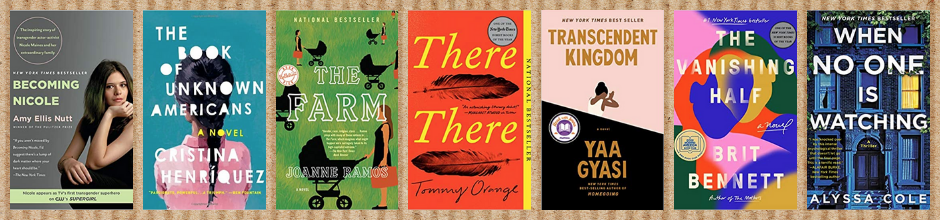
By now, my words should have you yearning for a great book and an even better discussion about it. But where can you join a book club? Try your local public library. They may already have one established. If not, they may be willing to work with you to get one started. Once you have picked a time, a place, and a book, you are ready to read. But what if everyone wants to read the same book, and you are having trouble finding enough copies of the same book? MLC has book club kits Mississippi libraries can check out for three months. Each kit contains ten copies of the same title and a discussion guide. At the time I’m writing this, MLC has over 150 Book Club Kits to choose from! If you are interested in finding out more details, visit https://mlc.lib.ms.us/programming-hub/ or email me at csimpkins@mlc.lib.ms.us. Here are some of the newest selections I’m most excited about: 

I have enjoyed my time participating in a book club and hope you can benefit from the same joy. Best of luck with your readings. Which book do you think would be a good selection to discuss and why? Sound off in the comments below!

Related Posts Plugin for WordPress, Blogger...