JavaScript disabled or chat unavailable.

Have a question?

We have answers!
Chat Monday-Friday, 8 AM - 5 PM (except MS state holidays)
Phone: 601-432-4492 or Toll free: 1-877-KWIK-REF (1-877-594-5733)
Text: 601-208-0868
Email: mlcref@mlc.lib.ms.us
Showing posts with label slavery. Show all posts

Wednesday, May 13, 2015

Tubman on the Money

The nonprofit organization Women on 20s has announced the winner of their online election to see who America thinks should be the first woman on United States paper currency. They announced the winner as Harriet Tubman yesterday and have petitioned the President to recommend to the Treasurer that the change be made by 2020, the 100 year anniversary of Women's Suffrage in America. Harriet Tubman was a fascinating woman who:
  • Was born with the name Araminta. She changed her name to Harriet, possibly in homage to her mother Harriet Ross, after she escaped slavery.
  • Was hit on the head when trying to help another slave avoid punishment. The resulting injury troubled her the rest of her life, bringing seizures, headaches, and blackouts.
  • Made at least nineteen trips on the Underground Railroad and helped nearly 300 slaves reach freedom in the North. She was never caught.
  • Was a nurse, laundry woman, cook, and spy during the Civil War. Once, she even led a raiding party!
  • Helped former slaves and orphans after the Civil War, starting schools and a home for the aged.
For more information, check out these excellent resources on Harriet Tubman and her life at your local public library or the Mississippi Library Commission:
Harriet Tubman
written by Marion Dane Bauer
Moses: When Harriet Tubman Led Her People to Freedom
written by Carole Boston Weatherford
illustrated by Kadir Nelson


Minty: A Story of Young Harriet Tubman
written by Alan Schroeder
illustrated by Jerry Pinkney

Harriet Tubman, Secret Agent: How Daring Slaves
and Free Blacks Spied for the Union During the Civil War
written by Thomas B. Allen
illustrated by Carla Bauer
Harriet Tubman: The Road to Freedom
written by Catherine Clinton
https://commons.wikimedia.org/wiki/File:Harriet_Tubman.jpghttp://www.womenon20s.org/campaign
"Tubman, Harriet Ross." Encyclopedia of Women Social Reformers. Santa Barbara: ABC-CLIO, 2001. Credo Reference. Web. 13 May 2015.

Friday, October 17, 2014

Book Club in a Box presents The Good Lord Bird


We've added so many new titles to our Book Club in a Box program this year! I'm going to try and feature most of them here on the blog at some point so all of you can see them and learn more.

We recently added The Good Lord Bird by James McBride to our collection. Published in 2013, The Good Lord Bird is a National Book Award for Fiction winner. Below is a summary of the book from The National Book Foundation's website.

"Henry Shackleford is a young slave living in the Kansas Territory in 1857, when the region is a battleground between anti- and pro-slavery forces. When John Brown, the legendary abolitionist, arrives in the area, an argument between Brown and Henry’s master quickly turns violent. Henry is forced to leave town—with Brown, who believes he’s a girl.

Over the ensuing months, Henry—whom Brown nicknames Little Onion—conceals his true identity as he struggles to stay alive. Eventually Little Onion finds himself with Brown at the historic raid on Harpers Ferry in 1859—one of the great catalysts for the Civil War.

An absorbing mixture of history and imagination, and told with McBride’s meticulous eye for detail and character, The Good Lord Bird is both a rousing adventure and a moving exploration of identity and survival."


Get more information about the book and see James McBride's acceptance speech for the National Book Award here.

Feel free to contact me for more information about this book and any others we have available through our program! You can reach me by phone at 601-432-4117 or email at amellon@mlc.lib.ms.us .

Our Book Club in a Box kits contain 10 copies of the title as well as discussion materials.

Monday, July 22, 2013

She Done What She Could

http://www.blockaderunner.com/Catalog/catpg9a.html
Webster's Blue
Black Speller
I've been searching for the first school shooting in Mississippi for the past day or so. I favor a three-pronged attack: print sources, Internet databases, and ye olde Internet search. You'd be amazed at what isn't available on the Internet! I was scanning a print book called From Cotton Field to Schoolhouse: African American Education in Mississippi, 1862-1875, which led me to The American Slave: A Composite Autobiography, wherein I found an incredibly moving story that cried out to be shared:

Belle Caruthers was born a slave. At the end of the War Between the States, she was one of 437,000 blacks set free (31). Most were completely illiterate. Belle was not. She had cared for a white baby as a slave and, "The baby had alphabet blocks and I learned my letters while she learned hers" (33). Belle later found a Webster's Blue Black Speller and used it to study. Her master kicked her when he found her pouring over its pages (33). This did not phase Belle in the least. "I found a hymnbook one day and spelled out, 'When I Can Read My Title Clear.' I was so happy when I saw that I could really read that I ran around telling all the other slaves" (34). I can imagine her excitement, can't you? It practically leaps from the page even now, over 150 years later.

http://www.findagrave.com/cgi-bin/fg.cgi?page=pv&GRid=12301446&PIpi=2281687
Tombstone of Belle G. Caruthers
She done what she could.
Belle went on to some further schooling herself; she then spent many years as a teacher in the Holly Springs area, passing on her love of and knowledge and learning. She married and raised a family. Belle also wrote for The South, the local county newspaper printed in Holly Springs. The Mississippi Department of Archives and History holds the newspaper for the years Belle would've written her column. I think a personal trip to MDAH is in order in the near future!

Do you see what happened there? I went into my search looking for one thing and came out with a great story and a new resource. (I can't wait to try this in my genealogy research!) Mrs. Belle may have passed away in 1938 at the age of 91, but I think she still has a lot to teach the world.

Blue Black Speller http://www.blockaderunner.com/Catalog/catpg9a.html
Gravestone at Hill Crest Cemetery - She Done What She Could: http://www.findagrave.com/cgi-bin/fg.cgi?page=gr&GRid=12301446
Rawick, George P. The American Slave: A Composite Autobiography Supplement, Series 1, Volume 7 Mississippi Narratives, Part 2. Westport, CT: Greenwood Press, 1977. Print.

Tuesday, June 19, 2012

Juneteenth


“ANOTHER MARCH: Negroes Freed By the Emancipation Proclamation Enter Union Lines at Newbern, N.C.”. Image courtesy The Atlanta Century.

On this day, in 1865, Texas slaves learned they were free nearly two years following President Abraham Lincoln’s Emancipation Proclamation issued on January 1, 1863.  The slaves did not know they were free until Union soldiers arrived in Galveston, Texas, and Major General Gordon Granger read from the President’s General Order No. 3:

“The people of Texas are informed that in accordance with a Proclamation from the Executive of the United States, all slaves are free.  This involves an absolute equality of rights and rights of property between former masters and slaves, and the connection heretofore existing between them becomes that between employer and free laborer.  The freedmen are advised to remain quietly at their present homes and work for wages.  They are informed that they will not be allowed to collect at military posts and that they will not be supported in idleness either there or elsewhere” (Gay 250).
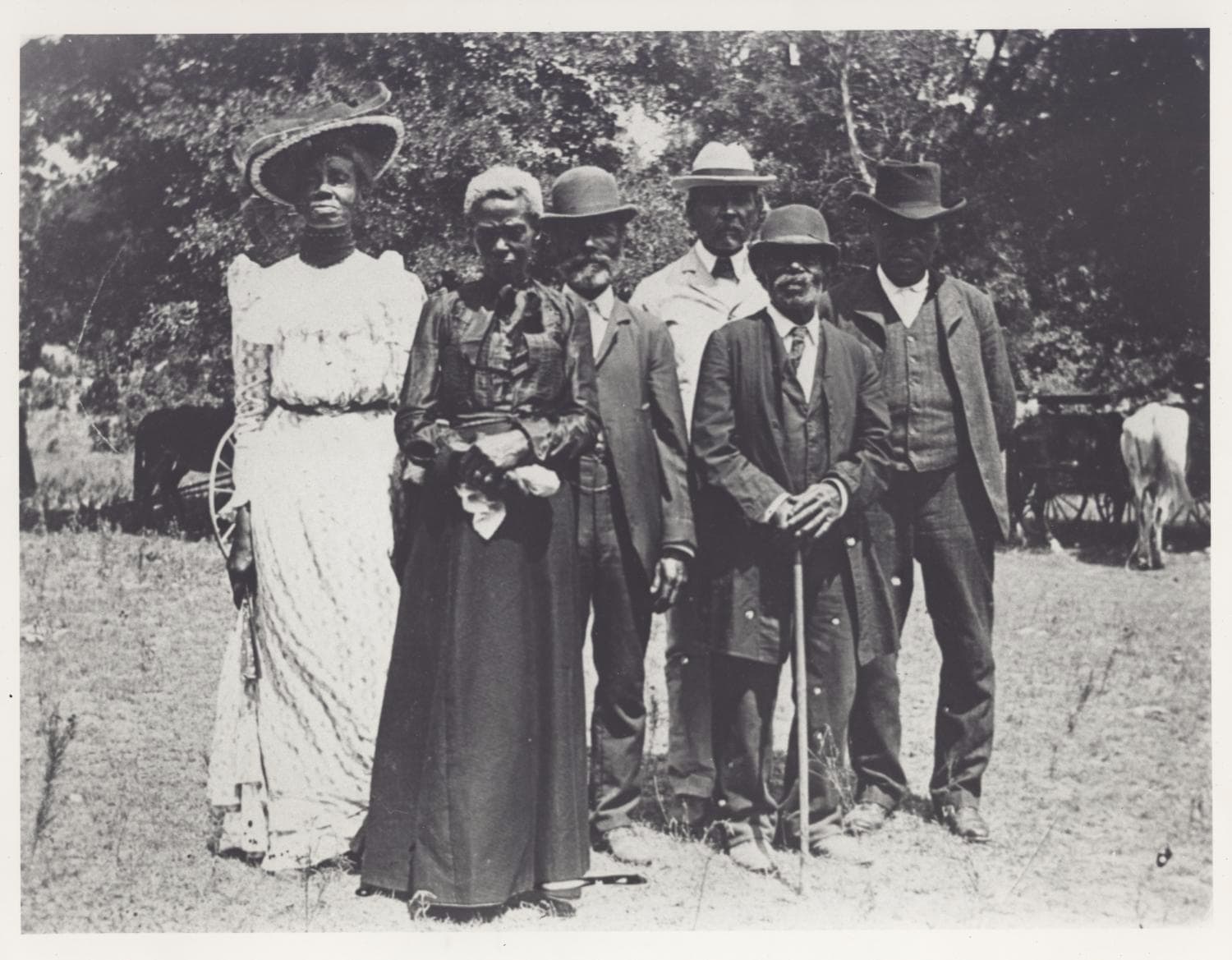
Image courtesy Austin History Center on Wikimedia

African Americans were forced to celebrate outside of the state of Texas during some early observances of Juneteenth.  This holiday, also known as African-American Independence Day, was passed by an act of Texas legislature in 1979, marking Juneteenth as a paid holiday.  Juneteenth’s first official celebration was held in 1980 after over a century of its observance spreading through the U.S. by African Americans who moved out of Texas to reunite with family members.  It eventually was observed as an unpaid state holiday in other states as well.  Mississippi became the 36th state to recognize Juneteenth, as of March of 2010, and is participating in a campaign to have it recognized as a National Day of Observance, like Patriot Day or Flag Day. 

Today, Juneteenth commemorations celebrate African-American heritage, renews interest in searching for African American ancestors, and provides an opportunity for family and friends to gather.  We have plenty of genealogy resources here at the Mississippi Library Commission.  Are you searching for long, lost relatives?  Are you trying to branch out your family tree?  We would love to help!


Gay, Kathlyn. African-American Holidays, Festivals, And Celebrations: The History, Customs, and Symbols Associated with Both Traditional and Contemporary Religious and Secular Events Observed by Americans of African Descent. Detroit, MI: Omnigraphics, 2007. Print

Image: Emancipation Day Celebration 1900

“Press Release”. National Juneteenth Observance Foundation. 25 March 2010. Web. 19 June 2012. < http://nationaljuneteenth.com/Mississippi.html>.

Shavin, Norman. The Atlanta Century: March,1860-May,1865 [vol.3, no. 48 (153) Sunday, January 25, 1863]. Atlanta, GA: I/D Publishing Company, 1966. Print

Related Posts Plugin for WordPress, Blogger...