JavaScript disabled or chat unavailable.

Have a question?

We have answers!
Chat Monday-Friday, 8 AM - 5 PM (except MS state holidays)
Phone: 601-432-4492 or Toll free: 1-877-KWIK-REF (1-877-594-5733)
Text: 601-208-0868
Email: mlcref@mlc.lib.ms.us
Showing posts with label WWII. Show all posts

Friday, June 6, 2014

D-Day: Books about the Beginning of the End of WWII

June 6 was forever seared into America's memory as D-Day in 1944. On that day seventy years ago, over 150,000 Allied troops landed on Normandy's beach to battle the Axis powers. The attack, known officially as Operation Overlord (referring to the land battle) and Operation Neptune (the naval part of the attack), led to an eventual Allied victory in Europe less than a year later. D-Day's cost was high; over 9,000 men were injured or killed that day. Putting an end to tyranny, though, was worth the price.

D-Day was immortalized in the highly acclaimed miniseries Band of Brothers and popular movies such as The Longest Day and Saving Private Ryan. Some great books have been written about D-Day as well. For instance, did you know that the miniseries Band of Brothers is based on Stephen Ambrose's book of the same name? The Mississippi Library Commission has copies in both regular and large print of this book about E Company, a group of men who, like many others, trained and bonded together, and fought together, and even died together. It's an absorbing read and adds even more detail that the miniseries missed.

D-Day: The Battle for Normandy by Antony Beevor is another fascinating book about this epic part of Word War II. This book is filled with maps, which we absolutely love, and gives more details of the battle from perspectives other than just America's side. Drop by MLC and pick this one up in large print for an in-depth look at June 6, 1944.


Looking for less action and more intrigue? Agent Garbo: The Brilliant, Eccentric Secret Agent Who Tricked Hitler and Saved D-Day by Stephen Talty is the book for you. It tells the story of Juan Pujol, a farmer, who became a double agent working for the Allies and deceiving the Germans. His deception was supreme: he convinced the Germans that an attack was aimed at Calais, hundreds of miles away from the Allies' landing point in Normandy. Stop by MLC to check this book out in regular print.

Mull this over on your way to check out your books: the D in D-Day may actually stand for Day. During World War I, the U.S. Army used the designations H-Hour and D-Day to indicate upcoming classified operations. Whatever the name of the day, we suggest commemorating those who fell in battle with one of these books or the many others we have to offer on World War II and D-Day.

http://www.army.mil/d-day/
http://www.cnn.com/2014/06/05/opinion/opinion-d-day-myth-reality/
http://www.pbs.org/wgbh/amex/dday/sfeature/sf_info.html

Wednesday, January 8, 2014

New Books - Epistolophilia

Did you know that books at the Mississippi Library Commission are available for check out to the general public? Simply bring in your current library card from a Mississippi public library, fill out this short application form, and you're set!

From time to time, we like to share with you the new books available at the Mississippi Library Commission. One of our new favorites is Epistolophilia by Julija Sukys. It details the life of Ona Simaite, a fascinating librarian who helped Jews in Lithuania during World War II. Check out our blog post about her from last year or come on in and check out the book. See you soon!


Monday, August 26, 2013

The Best Overdue Books Ever

Lithuania
I stumbled across a story last week which I've been waiting to share with you. An unlikely librarian in Lithuania is a new heroine of mine; that is, this unlikely librarian and her concocted story of some very important overdue books.

http://www.ushmm.org/wlc/en/media_ph.php?ModuleId=10005173&MediaId=484
Ona Simaite
Ona Simaite was born January 6, 1894 (some sources say 1899) in Akmenė, Lithuania. She worked at Vilnius University as a librarian and literary critic. The Nazi occupation of Lithuania began in 1940 and she saw the horrors of the Nazis up close. Simaite decided to act. She convinced the Nazis that Jewish students living in the ghettos had overdue library books that needed to be returned to the library. (Never underestimate the fear and awe that an overdue library book strikes in the hearts of men.) Once she had gained access to the Jewish ghetto, she brought in much needed supplies for the people trapped inside and brought out historical documents and texts for preservation purposes. She was finally found out in 1944 and captured by the Nazis. They tortured her and sentenced her to death. She escaped this fate when colleagues and others at her university spoke in her behalf. She was sent instead to the concentration camp in Dachau, and then later, to one in France. Simaite survived the war and died in Israel in 1970. She was designated Righteous Among the Nations by Yad Vashem in 1966.

This story just goes to show what a librarian with a strong purpose, a determined spirit, and a threat of some overdue books can do. If you'd like to learn more about this incredible woman, check out the book Epistolophilia by Julija Šukys. It's at the top of my to-read list.


http://www.credoreference.com/entry/chambdictwh/lithuania
http://www.oac.cdlib.org/findaid/ark:/13030/tf196n97td/admin/#bioghist-1.7.4
http://www.ushmm.org/wlc/en/media_ph.php?ModuleId=10005173&MediaId=484
http://www.yadvashem.org/odot_pdf/Microsoft%20Word%20-%206025.pdf

Thursday, November 4, 2010

There's Only One "S" In Saving

OK, y'all. It appears that for my entire life I have been suffering from the misconception that there is such a thing as Daylight Savings Time. Well, that just isn't so. The correct name for the devilment that occurs yet again this weekend is Daylight Saving Time--no extra "s." While you try to remember where you put the directions on how to change the clock on your car radio, let me fill you in on a few other DST nuggets.
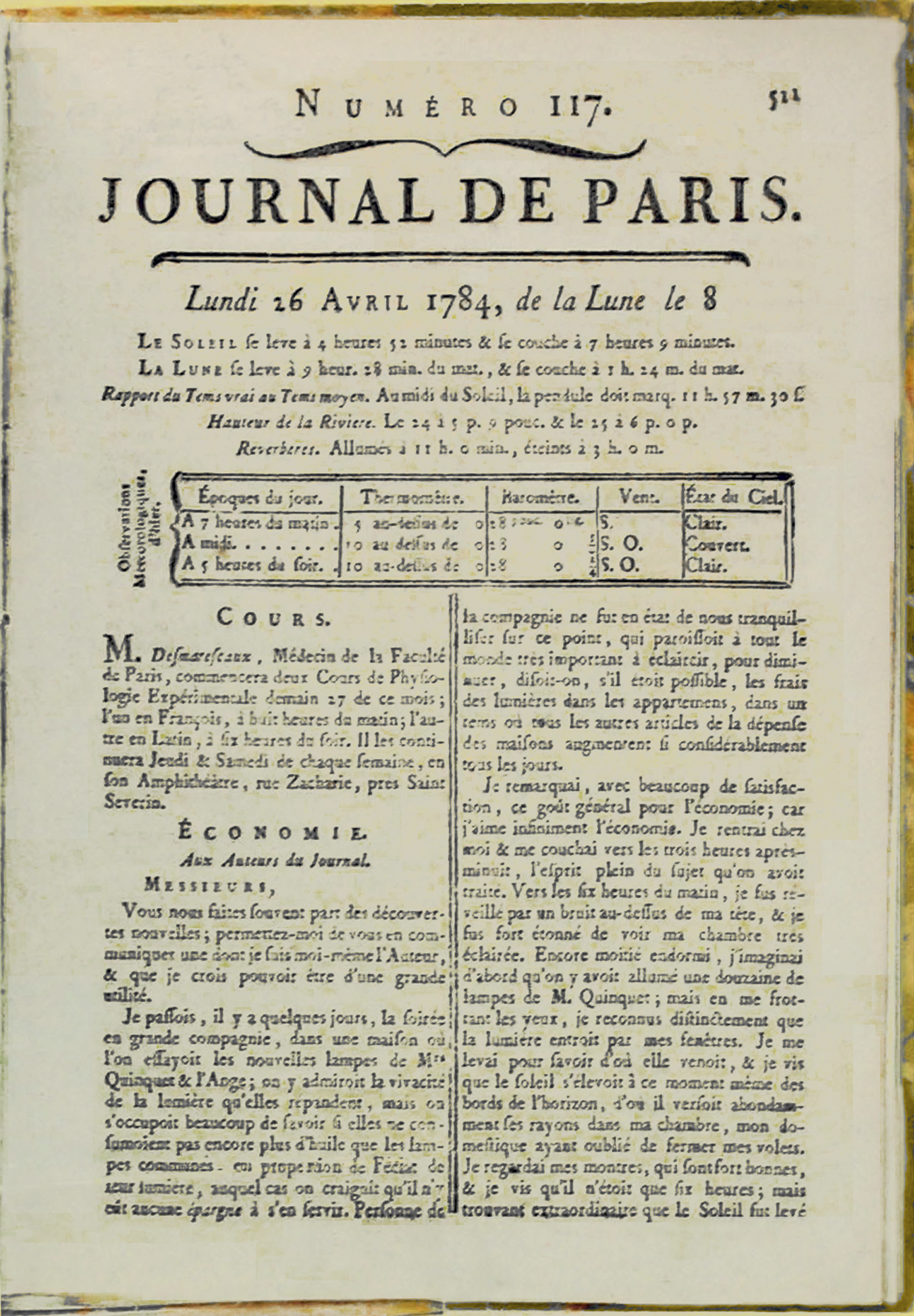
  • You remember Benjamin Franklin? Funny hair, glasses, one of the founding fathers of our country, invented things? Franklin penned an article that proposed “earlier opening and closing of shops to save the cost of lighting" while he was the American minister to France (Columbia).
  • Every spring and fall I try to remember when the big dates are. Every spring and every fall I can't remember without asking at least 20 other people who, guess what!, can't remember either. Here it is:

          I'm sure we could come up with an easy mnemonic to remember this... Tracy suggests starting with "The first Sunday of November is the day I can't remember." A gold star to whomever can find a good rhyme line for March!
  • If you venture forth to western Europe, you'll probably find that Daylight Saving Time starts the last Sunday of March and ends the last Sunday of October (Britannica). I am at a loss to explain why we can come up with standard time zones, but not a standard for saving time.
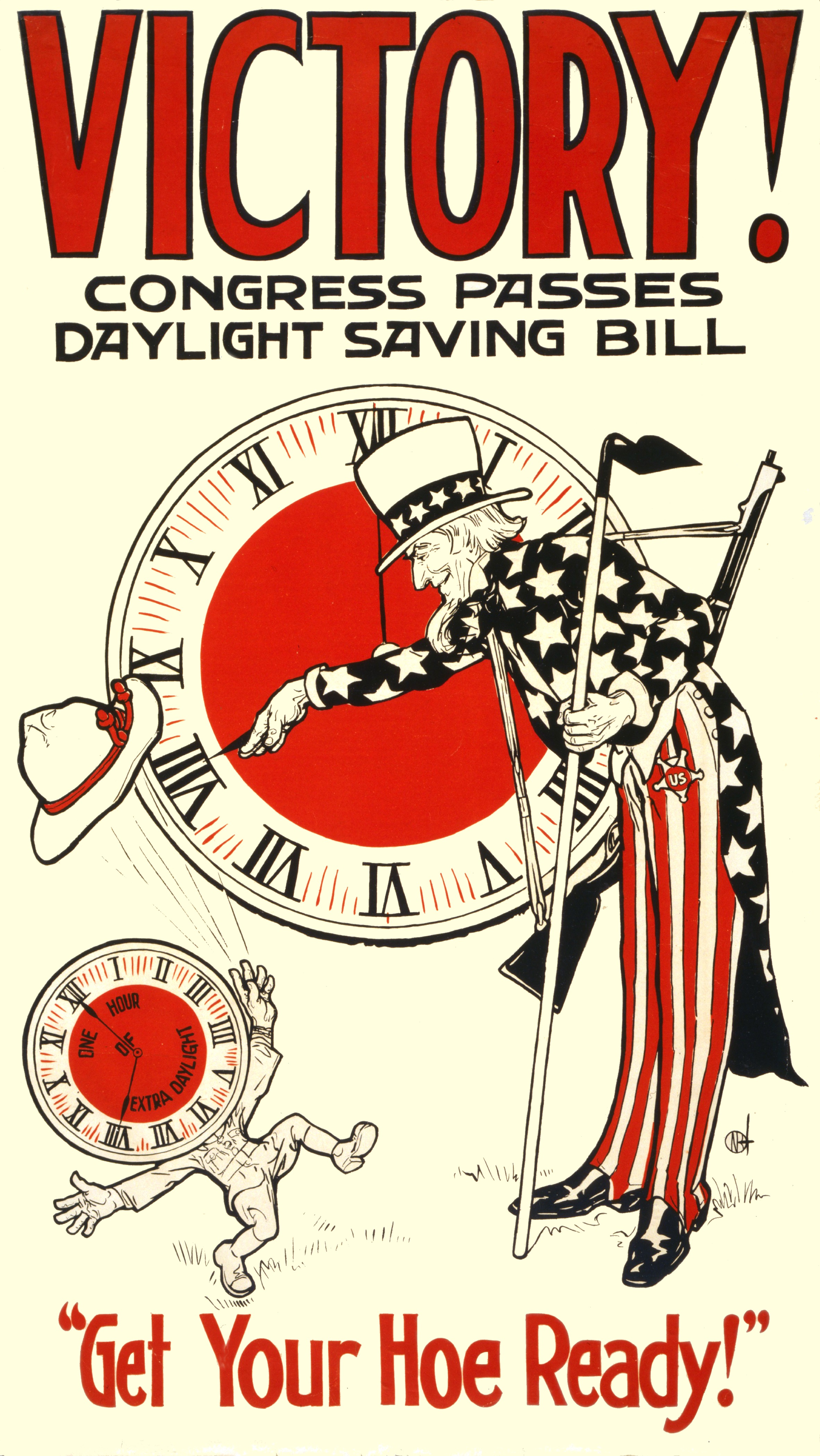
  • Daylight saving time was first attempted in modern times as a cost-saving method during war. The Germans, British, and Americans, among others, adopted this practice during WWI.
  • Americans also used Daylight Saving Time during WWII and the energy crisis of 1973-74, with many cities and states keeping a version of DST at other times while the rest of the country was not. All states except Arizona and Hawaii now follow the federal standard for DST (Columbia).
By the way, I haven't changed my car radio's clock for years. I gleefully ride about with reckless abandon for eight months of the year with the wrong time. I sure am glad I can't get a ticket for that! You try to be a bit more careful with time than me, and don't forget:

Spring Forward! Fall Back!

And you'll be fine!

Britannica Concise Encyclopedia. Chicago: Encyclopaedia Britannica, 2009. Credo Reference. Web. 03 November 2010.
"daylight saving time." The Columbia Encyclopedia. New York: Columbia University Press, 2008. Credo Reference. Web. 03 November 2010.
http://commons.wikimedia.org/wiki/File:Franklin-Benjamin-Journal-de-Paris-1784.png
http://commons.wikimedia.org/wiki/File:Victory-Cigar-Congress-Passes-DST.jpeg

Thursday, October 7, 2010

Uncle Sam Wants You (To Get In The Water!)

A few weeks ago, I had to search through the microfilm for an article about a US transport ship that had hit a mine back in 1942. While I had to spend a little more time than usual trying to find the article, it was well worth it in the end. At first, there was some confusion as to when the ship actually sank. It turns out that although the ship went down towards the end of October, it was not released in the media until six weeks later. That's a far cry from our instant news of today, and yet, there were still journalists "embedded" with the troops.

The 22,000 ton ocean liner hit a friendly mine and started sinking quickly. The captain of the ship managed to run it aground on a coral reef (!) and proceeded to evacuate the ship in a most orderly fashion. All of the soldiers had been sent to quarters, and there they waited, playing music and passing the time, until their sections were called. Then they joined the throngs that were doing this:

Have I ever mentioned my extreme fear of heights? I'm not sure I could have climbed down the side of this ship! It seems that several of the soldiers had a bit of trouble getting off the big boat, too.
The rescue boat that carried the writer to the ship's side found one young soldier clambering down a rope that was fifteen feet short of the water. He was very calm. He held to the rope with his two hands and looked down at us.
"Jump," our coxswain shouted.
"I can't swim," retorted the soldier.
"Jump, we'll catch you," we all shouted.
"Well, I don't know," the soldier mused. "I can't swim."
A stream of profanity was directed at him, but he swung there gently, listening us out, apparently too polite to interrupt. Then he said:
"Well, all right, but I can't swim a stroke." Then he began to count.
"One," he said; "two, three," and paused.
"Well, here goes," he shouted, counting, "four, five, six, and one for good measure."
When he got to "nine," he let go and hit just off our bow. He sank like a stone. We waited, boat hook ready for him to come up. It seemed he never would come up, but finally he broke water and we hauled him on board. Then we found out he had jumped with a fully loaded cartridge belt around his waist and had just plummeted on down. When he revived, spluttering, he protested: "I told you fellows I couldn't swim." (Troops, NYT)
I wonder what he was going to do with that fully loaded cartridge belt in the ocean. Perhaps it was his special fully loaded cartridge belt?

What could have been a total disaster resulting in large loss of life transpired with only two deaths. Or wait, was it three? Or maybe four... Initial reports (from 1942) said that as many as four or five men died, but looking at information from after the war points to only two men out of over five thousand that died (pacificwrecks.com) What a beautiful miracle to come out of this:


http://www.pacificwrecks.com/ships/usn/president_coolidge.html
Wolfert, Ira. "Troops on Lost Ship Sing During Rescue." New York Times. 16 Dec. 1942: A1. Print.

Wednesday, August 11, 2010

Hogan's Heroes? Not Quite!

Yesterday, a Meebo patron inquired as to whether or not Butts Park in Clinton is located at the site of a long-forgotten German POW camp. After some initial searching, I contacted Mike Allard, local Clinton historian. According to Mr. Allard, Butts Park is directly west of and abuts the former Camp Clinton. Here are a few fast facts:
  • Clinton was actually the site of one of four POW camps in Mississippi during World War II. The others were Camp Como, Camp McCain (near Grenada), and Camp Shelby (New Southern View).
  • It was actually more cost effective to ship the POWs to Mississippi rather than keep them in Africa. That's because instead of trying to ship supplies to both their troops and prisoners, they could fill their empty supply ships with prisoners and send them stateside (MS History).
  • General Hans-Jürgen Von Arnim, Hitler's replacement for Rommel, was one of the 3,400 POWs at Clinton. It is rumored that he used his car and driver (Ahh! The perks of being a general!) to escape to the one place in the surrounding area with air conditioning: the Jackson movie theatre (New Southern View).
  • The enlisted prisoners in Clinton were paid 80 cents an hour to build a mile square working model of the Mississippi River Basin (MS History). The model was in use until the late 1980s/early 1990s, when the Corps of Engineers moved to sole use of their model in Vicksburg (Allard).
In the early 1970s, the camp was declared surplus and eventually given to Mississippi College. The site of the model was given to the city of Clinton.

I now have the irresistible urge to read The Summer of My German Soldier. I wonder why!

Allard, Mike. Personal interview. 10 Aug. 2010.
http://www.newsouthernview.com/pages/nsv_shm_pows_camp_clinton.html
http://mshistory.k12.ms.us/articles/233/german-prisoners-of-war-in-mississippi-1943-1946

Wednesday, March 4, 2009

Wisdom from Life

I love shoes. I think most women like (love) shoes. I’m always keeping an eye out for those new shoes that would be perfect with my wardrobe. I recently saw a pair at Nine West that I have been tempted--so tempted--to buy.

And then, I saw this:
It was prepared by the War Advertising Council and appeared in the June 5, 1944 issue of Life Magazine. The War Advertising Council was founded in 1941, and is now known as simply the “Ad Council.” The War Advertising Council campaigned during WWII to encourage Americans to buy war bonds and do other things to support the war effort, including conservation of money and resources.
They are also the ones responsible for Rosie the Riveter, Smokey the Bear, McGruff the crime dog, and Vince and Larry, the crash-test dummies. They now have campaigns that cover all types of issues, such as energy efficiency, lifelong literacy, and cyber bullying prevention. To learn more about the Ad Council, visit http://www.adcouncil.org/
This particular ad grabbed my attention right away. I thought it was very interesting, especially when you consider the state of our current economy. When I was younger, I watched my grandmother take a piece of used aluminum foil, wash it off, dry it, and put it in a drawer. I thought that was so strange! I had never seen anyone do that before.

What I didn’t realize at the time was that my grandmother, who grew up during the Great Depression, learned to conserve from a very young age. She continued to do so even when she was 80 years old and had plenty of money to buy more aluminum foil.

While I will probably never be one to start saving pieces of aluminum foil, I can definitely learn from the actions of my grandmother and others who lived through the Great Depression and WWII. To them, conservation was a necessary part of life. It was a responsibility that they gladly carried for themselves, their families, and their country.

The ad in Life Magazine is a little snapshot of the history of our nation. But the more I think about it, the more I think that it applies to my life today.

I guess that those multi-leather Nine West flats with the cute little buckle will just have to wait. At least, for now.
References:
"United States War Message." Advertisement. Life Magazine 5 June 1944: 111.
Related Posts Plugin for WordPress, Blogger...