Elisabeth Scott
Social Media and Reference Librarian
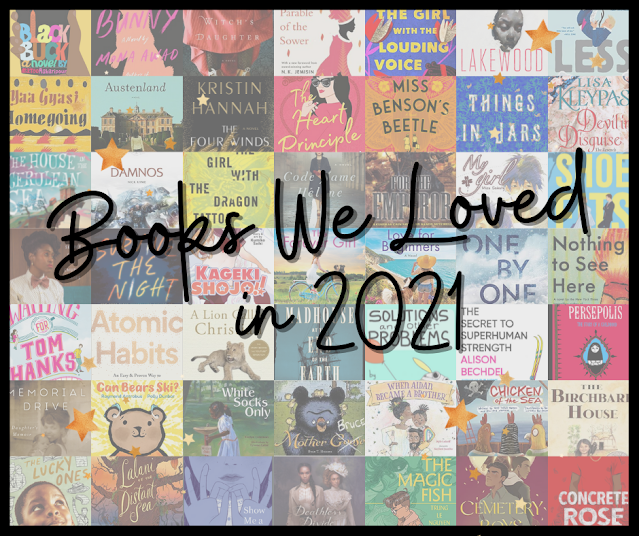
It's the "best of" reading list you've all been waiting for! Every year, MLC staff put together their favorite books--novels, picture books, comics, nonfiction, what have you-- and post it here on our lovely blog for you, our dear readers. Hyperlinked titles are available in MLC's collection and many of these books are also available at your Mississippi public library. We've been sharing these lists for several years, so if you're looking for book recs you should check out some of our faves from years past: 2016 part 1, 2016 part 2, 2017 adults, 2017 kids, 2018, 2019, and 2020. Without further ado, these are the books MLC staff loved reading this year.

Fiction
Black Buck (2021)
Mateo Askaripour
A look at the modern salesperson of today and the insanity of it all. Plus the author breaks the fourth wall in such a clever way.
Bunny (2019)
Mona Awad
Samantha Mackey, an MFA student at a prestigious university, REALLY doesn't like the girls in her fiction writing cohort: four rich girls who all call each other Bunny. But as Samantha gets closer to the Bunnies, she discovers a dark world of secrets, desire, and a sinisterness behind the Bunnies she never would have expected. A mixture of Heathers and The Secret History with a BIG dose of bonkers, Awad writes a darkly compelling page-turner of a book.
The Witch's Daughter (2008)
Paula Brackston
I picked this up at the Starkville Public Library Friends book sale on a site visit. I enjoyed the historical witchy time travel and romance aspects. I actually bought the second book because I enjoyed the first one so much. Book one was an easy/quick read.
Parable of the Sower (1993)
Octavia E. Butler
I love dystopian fiction, so I've been going back to read some of the classics. Parable of the Sower is hands down the type of masterpiece I was hoping to find.
Lakewood (2020)
Megan Giddings
How far would you go to help the ones you love? This dystopian work ponders that question while considering class and race in medical experimentation. This page-turner kept me guessing who Lena, the main character, could trust and when she would be pushed too far.
Less (2017)
Andrew Sean Greer
I finally read this after so many people have recommended it. Arthur Less's escape becomes his journey. This book showed me that you can love a book even when you don't agree with the ending. Beautiful writing. I wish I could meet Arthur Less IRL.
Homegoing (2016)
Yaa Gyasi
Austenland (2007)
Shannon Hale
Jane Hayes, a graphic designer in her 30s, has a problem: no real man will ever match up to her love for Mr. Darcy. In order to cure herself of this obsession, she goes to an immersive Jane Austen theme park... though she doesn't expect to find love in the process. This is a cute, short, quick read (under 200 pages!) perfect for anyone who's spent a decent amount of time dreaming of Colin Firth in a wet shirt.
The Four Winds (2021)
Kristin Hannah
Both empowering and heartbreaking, this well-researched work shows the struggle of so many families during a not-so-often talked about point in history, the Great Depression and the Dust Bowl. Even though the characters kept enduring hardships, their perseverance kept me coming back.
The Heart Principle (2021)
Helen Hoang
Miss Benson's Beetle (2020)
Rachel Joyce
Offbeat, historical, British fiction about one woman's search for the golden beetle of New Caledonia. It brought me to tears. I would read it again. A beautiful, moving, witty book.
Things in Jars (2019)
Jess Kidd
Devil in Disguise (2021)
Lisa Kleypas
T.J. Klune
Damnos (2013)
Nick Kyme
I'm a huge fan of the Warhammer 40,000 universe, and this book features a massive war between two of my favorite factions: the Emperor's Ultramarines and the ancient alien Necrons. The book is almost entirely action, but it does slow down enough to get the human characters' perspectives. The strategic planning and tactics used by the soldiers are also excellent.
The Millenium series
Stieg Larsson
The Girl with the Dragon Tattoo (2005)
The Girl who Played with Fire (2006)
The Girl who Kicked the Hornet's Nest (2007)
Code Name Hélène (2020)
Ariel Lawhon
For the Emperor (2003)
Sandy Mitchell
While also set in the Warhammer 40,000 universe, this book is vastly different in tone from Damnos, following a political officer who has managed to stumble his way into becoming an Imperium-wide hero. Ciaphas Cain is an unconventional hero who is highly aware of his own cowardly ways, and desires nothing more than to remain out of danger. His actions, while self-serving in motive, also serve the best interests of the soldiers under his command, and he gains their trust and admiration by being cautious and careful with their lives.
My Girl (2007-2010)
Sahara Mizu
This
Japanese comic series follows an office worker who learns that his old
lover has died in an accident, leaving him to raise a daughter he never
knew he had. It's simultaneously sad and wholesome, as he's thrust into
being a single father while losing the love of his life, as he does his
best to provide the love and support that his daughter needs.
Julie Murphy
Deesha Philyaw
Flawless. Each of the stories in this slim volume is pure perfection.
Survive the Night (2021)
Riley Sager
The Forever Girl (2021)
Jill Shalvis
Love for Beginners (2021)
Jill Shalvis
One by One (2020)
Ruth Ware
Nothing to See Here (2019)
Kevin Williams
Lillian is called on by a former best friend she rarely exchanges letters with for a major favor; she wants Lillian to come take care of her husband's twin children from a previous marriage while he is making moves up the political ladder. The catch is no one can know about it/them, and they spontaneously combust when they have heightened emotions. The narrator does a wonderful job incorporating Southern accents naturally in a story that had me cracking up.
Waiting for Tom Hanks (2019)
Kerry Winfrey

Nonfiction
James Clear
A Lion Called Christian: The True Story of the Remarkable Bond Between Two Friends and a Lion (1971)
Anthony Bourke, John Rendall, George Adamson (foreward)
I tend to read a lot of science fiction, but this is the book that touched me the most this year. Someone recommended it to me, I put it on my TBR, and it stayed there for over two months. It's a thought-provoking look at the plight of many exotic animals all over the world. Some live out their lives in very restrictive situations. There is a YouTube series that goes with this story, but it was compiled years after the books was published. It consists of all of the videos that were made when the authors had Christian in their care.
Julian Sancton
In 1897, the Belgian ship Belgica is sailing to Antarctica, to explore the continent. Unfortunately, it gets frozen in and has to spend the winter in one of the most inhospitable places on Earth as disease and madness start to spread through the crew. Sancton does an amazing job describing this lesser-known voyage that's part horror story, part adventure story, all delivered with a beautifully novel-like touch.

Biography/Memoir
Solutions and Other Problems (2020)
Allie Brosch
Alison Bechdel
Marjane Satrapi
This
memoir of the Iranian Revolution, told from the perspective of a young
girl, is shown in stark black and white panels. As she grows older and
the situation in Iran worsens, a young Satrapi grapples with the trials
of adolescent rebellion alongside the tolls of war. I can't wait to read
book two.
Natasha Trethewey
Trethewey's words are so lush, so poignant, and so overwhelmingly beautiful that I was completely transfixed the whole journey through this short memoir. Could you expect anything less from this former Mississippi Poet Laureate and two-time United States Poet Laureate?

Picture Books
Can Bears Ski? (2020)
Raymond Antrobus and Polly Dunbar (illustrations)
Author Antrobus, who is Deaf, and illustrator Dunbar, who is partially Deaf, team up for this insightful and sweet look at childhood deafness.
White Socks Only (1996)
Evelyn Coleman and Tyrone Geter (illustrations)
I love picture books: the art, the spare text, and the way they combine together to convey stories to children. White Socks Only was a unexpected breath of fresh air. I'll be recommending this one a lot.
Mother Bruce series
Ryan T. Higgins
The Bruce Swap (2021)
Bruce's Big Fun Day (2019)
Bruce's Big Move (2017)
Bruce's Big Storm (2019)
Hotel Bruce (2016)
Mother Bruce (2015)
Santa Bruce (2018)
Spring Stinks (2021)
When Aidan Became a Brother (2019)
Kyle Lukoff and Kaylani Juanita (illustrations)
A little boy worries that his new sibling will have to confront uncomfortable things in their life, perhaps even things as tough as when he transitioned fully into being a boy. He sets out to make sure this won't happen and his parents provide soothing support to guide him. Super sweet and affirming.
Chicken of the Sea (2019)
Viet Thanh Nguyen, Ellison Nguyen, Thi Bui (illustrations), and Hien Bui-Stafford (illustrations)
An inter-generational story about pirate chickens--a must read!

Middle Grade
The Birchbark House (1999)
Louise Erdrich
Set just in the same neck of the woods and a mere thirty years before the events of Little House on the Prairie, this middle grade book introduces us to a little Ojibwe girl named Omakayas and her family. Erdrich delves deep into small aspects of daily life in this little community and earth-shattering events from the wider world that affect them. I can't wait to read the entire series.
The Lucky Ones (2022)
Linda Williams Jackson
Robert Kennedy's Southern Poverty Tour lends itself as a backdrop to this tale of determination, hope, and family love. Look for it in 2022!
Lalani of the Distant Sea (2019)
Erin Entrada Kelly
Inspired by Filipino folklore, this mythic tale of pluck and fortitude had me cheering for Lalani, who must save the people of her tiny village. I gobbled it up in a day.
Show Me a Sign (2020)
Ann Clare LeZotte
Have you heard about the Deaf community who lived on Martha's Vineyard in the early 1800s? LeZotte sets her suspenseful book of courage on the peaceful island.

Young Adult
Deathless Divide (2020)
Justina Ireland
The Magic Fish (2020)
Trung Le Nguyen
I love this graphic novel with all my heart. The interwoven fairy tales, the relationship between Tiến and his mother, the lovely, expressive art... this is the perfect coming out story.
Kageki Shojo!! (2021-2022)
Cemetery Boys (2020)Kumiki Saiki
Sarasa
Watanabe is a loud, brash girl who's set her sights on playing her
favorite role on the stage. Ai Narata is a closed-off girl who just
doesn't want to deal with men. In order to achieve their dreams, the two
enroll in a prestigious all-girls theater school. This manga series
isn't afraid to tackle tough subjects, and the bright and infectious
personalities of our two leads make for a compelling read.
Aiden Thomas
Brujos and ghosts and romance, oh my!
Concrete Rose (2021)
Angie Thomas
If you loved The Hate U Give, you have to read its prequel Concrete Rose. Angie Thomas is spectacular yet again.
Have you read any of these books? What were your favorite reads this year? Let us know in the comments!