JavaScript disabled or chat unavailable.

Have a question?

We have answers!
Chat Monday-Friday, 8 AM - 5 PM (except MS state holidays)
Phone: 601-432-4492 or Toll free: 1-877-KWIK-REF (1-877-594-5733)
Text: 601-208-0868
Email: mlcref@mlc.lib.ms.us
Showing posts with label WWI. Show all posts

Wednesday, November 9, 2011

Stay or Go: Romanov Edition

 
Kudzu, the Mississippi weed

One of the never-ending tasks of a librarian is to "weed" the collection. That means exactly what it says: like a massive growth of kudzu, bad books are trying to take over the library. Librarians continuously cull to make sure that the best books are available for their patrons use. It's hard. I love books, and I think that each and every one of them is valuable in its own right--or at least was at one point in time. That said, no one wants to go to the library and find crumbling, moldy, mildewed books. Books that are no longer relevant (think travel guides from 30 years ago or a history of Europe that ends in 1985) aren't popular either. A website called Awful Library Books is devoted to promoting good library books and to removing the baddies from the shelf. A clever acronym has even been coined to help in the weeding process:

  • M - Misleading
  • U - Ugly
  • S - Superseded
  • T - Trivial
  • I - Irrelevant
  • E - Found Elsewhere
Let me tell you, MUSTIE has helped me out in a pinch when trying to decide if a book should stay or go.

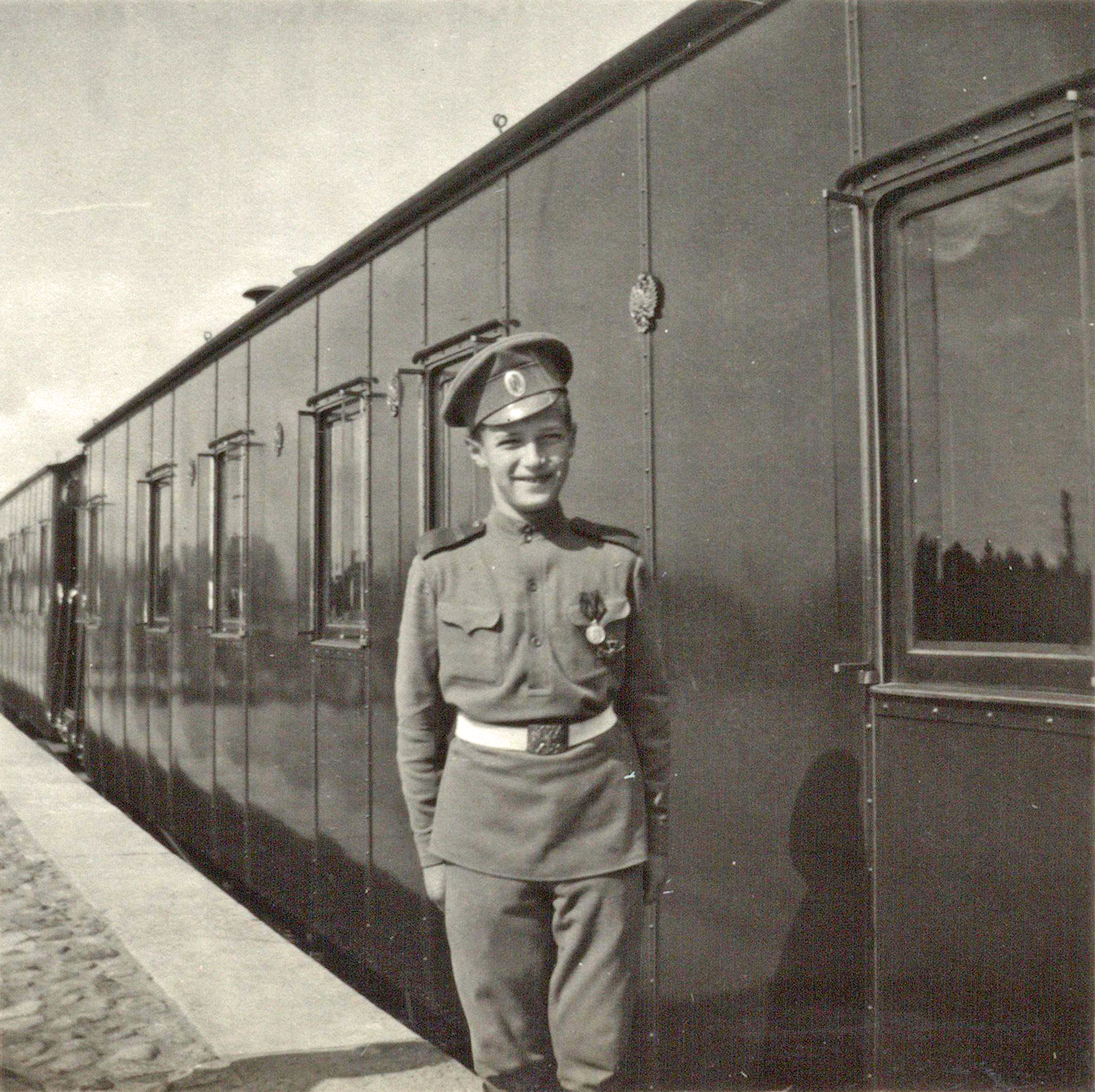
Alexei Romanov
Last week, I watched Russian Revolution in Color, which was excellent. Later, I was browsing the shelves for books to put in a display and ran across The Escape of Alexei, Son of Tsar Nicholas II: What Happened the Night the Romanov Family Was Executed. (This is always dangerous. I also managed to pick up Rising Tide and Marooned: The Strange but True Adventures of Alexander Selkirk, the Real Robinson Crusoe. I have too many books to read!) Wanting to stay on my Russian history kick, I took Alexi home and was looking forward to reading about this theory. I'd never heard a tale about the Tsar's son surviving, only Anastasia. The book wasn't a bad read, but it presupposed knowledge of tiny details of the Russian Revolution. Even my recent viewing of Russian Revolution in Color wasn't helping. And the NAMES! They're enough to make you want to run screaming from the library! (For example, Konstantin Alexeyevich Myachim also went by Vasily Vasilievich Yakovlev. That's quite an alias.)

Taking a break, I decided to do a small web search in order to update my Romanov savvy (And to take a break from the names! Yes, I struggled when I read War and Peace.) I hit Wikipedia and then moved on to some of their external links (This is one of my favorite at-home search methods.) I came across some interesting sites, like this one, and this one. Imagine my disappointment to find that the two bodies that had been missing when my book was published in 1998 had been found and identified in 2007. I don't know how I missed that news flash. My impromptu research made my interest in Alexi completely fizzle.

I'm recommending that this particular book leave our collection. I now consider it contaminated with a great big "M". (That's misleading, remember?!) It would be perfect for a library that has a special collection on Russian history or the Romanovs, but not the Mississippi Library Commission. I checked our collection (You can do that here!) and found that we don't have anything that has been published in this area in the past several years. My next step is to find an up-to-date volume that covers this time frame in history. I'm leaning towards one of these two: The Resurrection of the Romanovs: Anastasia, Anna Anderson, and the World's Greatest Royal Mystery or The Last Days of the Romanovs: Tragedy at Ekaterinburg. Now, that sounds better, doesn't it?
http://commons.wikimedia.org/wiki/File:Alexei_tren.jpg
http://commons.wikimedia.org/wiki/File:Kudzu_field_horz1.JPG
https://www.tsl.state.tx.us/ld/pubs/crew/index.html

Tuesday, June 14, 2011

Titanic Moments

Alas! One of our favorite people is leaving the Reference Department at the Mississippi Library Commission for other climes. (Never you mind that the clime in question is just down the street!) As a tribute to this momentous occasion, I thought we would send her off with a few nuggets on her favorite subject: The Titanic.
  • The first oddity I ran across mentions that the Titanic, contrary to popular belief, was not the first ship to use SOS as a distress signal. That distinction goes to a ship called the Azaoahoe. It ran into trouble back in August of 1909, a full 2 1/2 years before the Titanic's disaster in April of 1912. (SOS Oxford)
  • Another peculiarity regarding the distress calls that went out April 15? SOS being a fairly new distress signal, the Morse code operator, Jack Phillips used "CDQ," an older signal, at first. Another operator suggested he try "SOS" because "this might be your last chance to send it." (Fran SOS) Ahhh, prophetic last words...
  • Many people know that the Titanic had two sister ships: the Olympic and the Britannic. Both ships were requisitioned during World War I. The Britannic served as a hospital ship. She struck a mine in 1916 and sank, thankfully losing only 30 out of over 1,000 people. The Olympic had quite a different life. Serving as a troop carrier, the Olympic was fired upon twice by a submarine in 1918. Instead of trying to outrun the sub, the captain turned the Olympic and rammed the submarine, gashing a hole in it and sinking it. (http://www.titanic-whitestarships.com/) Seems that the captain was determined to keep at least one of the trio afloat!
Although I'm sure that Brandie had prior knowledge of my Titanic nuggets, I had fun tracking them down for her. We all wish her the best of luck at her new job. We know it won't turn out anything like the Titanic!

Fran, Y. (n.d). SOS: the signal that has saved thousands turns 100. Times, The (United Kingdom). Retrieved from EBSCOhost.
"‘SOS’" The Oxford Companion to Ships and the Sea. Ed. I. C. B. Dear and Peter Kemp. Oxford University Press, 2007. Oxford Reference Online. Oxford University Press. Mississippi Library Commission. 14 June 2011 http://www.oxfordreference.com/views/ENTRY.html?subview=Main&entry=t225.e2271
http://upload.wikimedia.org/wikipedia/commons/f/fd/RMS_Titanic_3.jpg
http://www.titanic-whitestarships.com/Britannic1_1914.htm
http://www.titanic-whitestarships.com/Olympic_1911.htm

Thursday, November 4, 2010

There's Only One "S" In Saving

OK, y'all. It appears that for my entire life I have been suffering from the misconception that there is such a thing as Daylight Savings Time. Well, that just isn't so. The correct name for the devilment that occurs yet again this weekend is Daylight Saving Time--no extra "s." While you try to remember where you put the directions on how to change the clock on your car radio, let me fill you in on a few other DST nuggets.
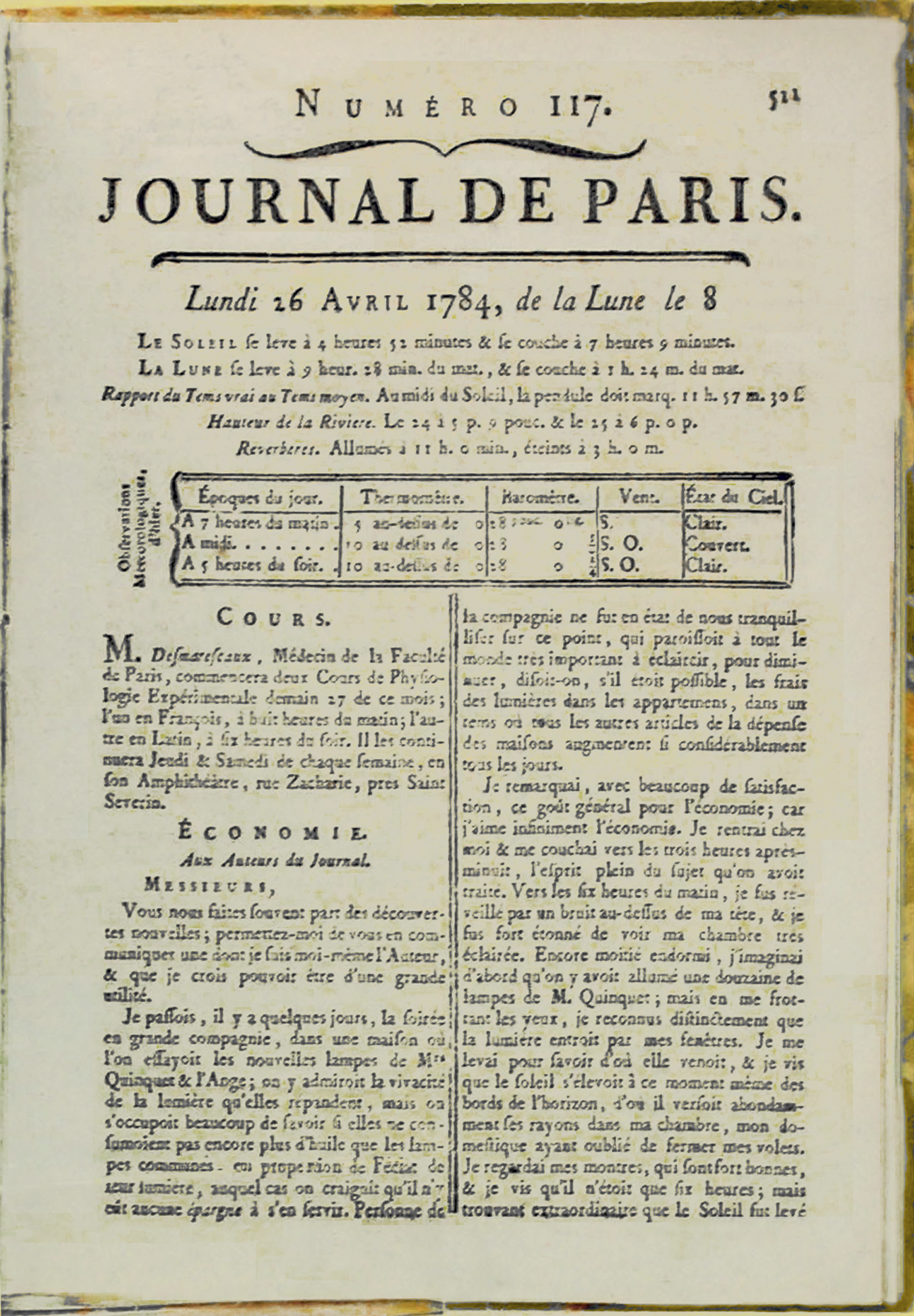
  • You remember Benjamin Franklin? Funny hair, glasses, one of the founding fathers of our country, invented things? Franklin penned an article that proposed “earlier opening and closing of shops to save the cost of lighting" while he was the American minister to France (Columbia).
  • Every spring and fall I try to remember when the big dates are. Every spring and every fall I can't remember without asking at least 20 other people who, guess what!, can't remember either. Here it is:

          I'm sure we could come up with an easy mnemonic to remember this... Tracy suggests starting with "The first Sunday of November is the day I can't remember." A gold star to whomever can find a good rhyme line for March!
  • If you venture forth to western Europe, you'll probably find that Daylight Saving Time starts the last Sunday of March and ends the last Sunday of October (Britannica). I am at a loss to explain why we can come up with standard time zones, but not a standard for saving time.
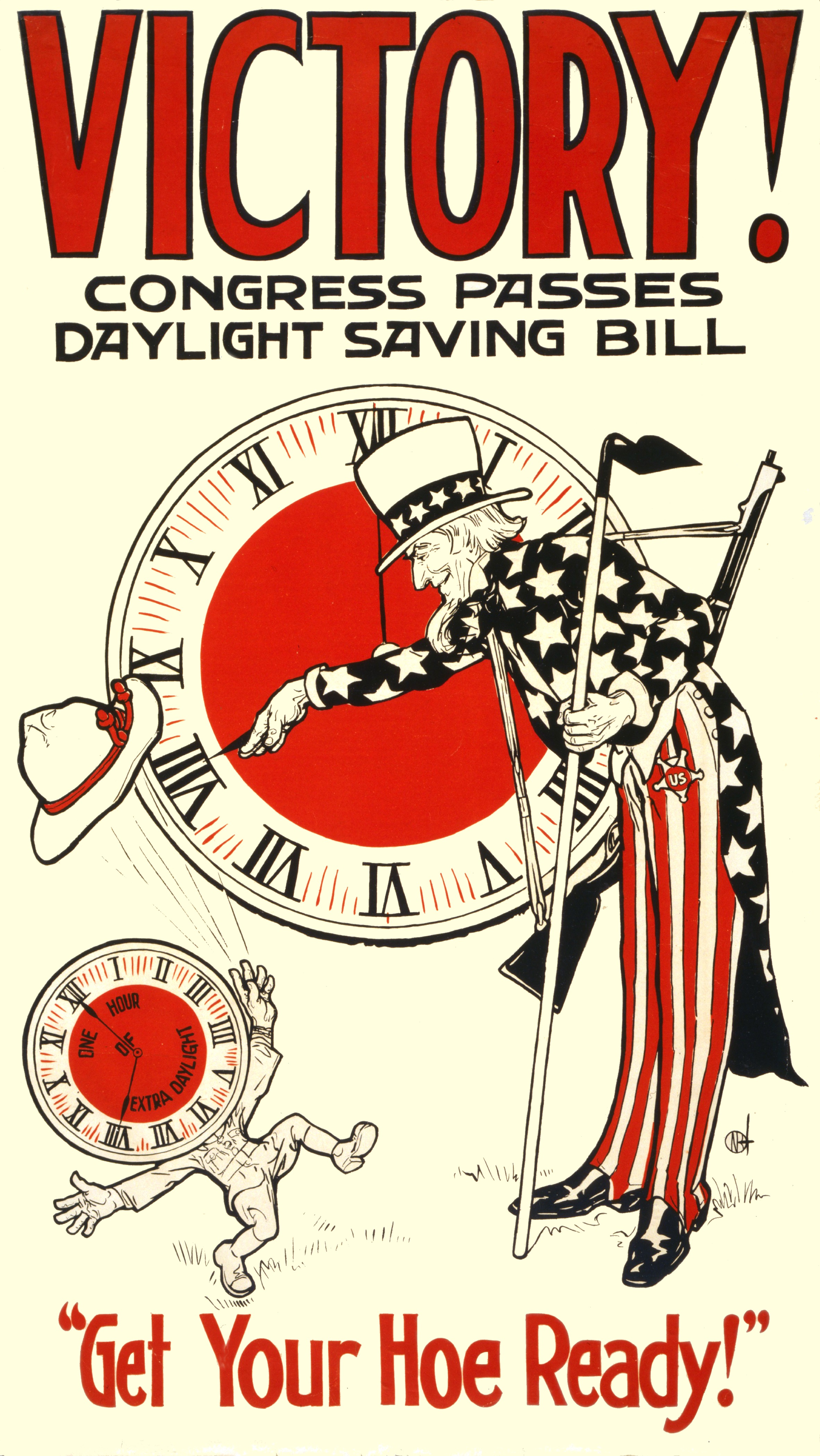
  • Daylight saving time was first attempted in modern times as a cost-saving method during war. The Germans, British, and Americans, among others, adopted this practice during WWI.
  • Americans also used Daylight Saving Time during WWII and the energy crisis of 1973-74, with many cities and states keeping a version of DST at other times while the rest of the country was not. All states except Arizona and Hawaii now follow the federal standard for DST (Columbia).
By the way, I haven't changed my car radio's clock for years. I gleefully ride about with reckless abandon for eight months of the year with the wrong time. I sure am glad I can't get a ticket for that! You try to be a bit more careful with time than me, and don't forget:

Spring Forward! Fall Back!

And you'll be fine!

Britannica Concise Encyclopedia. Chicago: Encyclopaedia Britannica, 2009. Credo Reference. Web. 03 November 2010.
"daylight saving time." The Columbia Encyclopedia. New York: Columbia University Press, 2008. Credo Reference. Web. 03 November 2010.
http://commons.wikimedia.org/wiki/File:Franklin-Benjamin-Journal-de-Paris-1784.png
http://commons.wikimedia.org/wiki/File:Victory-Cigar-Congress-Passes-DST.jpeg
Related Posts Plugin for WordPress, Blogger...