

The Mississippi Library Commission is committed – through leadership, advocacy, and service – to strengthening and enhancing libraries and library services for all Mississippians.
JavaScript disabled or chat unavailable.
Showing posts with label animals. Show all posts
Showing posts with label animals. Show all posts
Thursday, August 13, 2015
Doe, A Deer

Tuesday, May 12, 2015
On Runcible Spoons and Owls and Pussy-Cats

And:The Owl and the Pussy-cat went to seaIn a beautiful pea-green boat
It was first published in 1871 in a collection called Nonsense Songs, Stories, Botany, and Alphabets. If you have never read the poem in it's entirety, you can do so here. It's quite a treat!Pussy said to the Owl, "You elegant fowl!How charmingly sweet you sing!
Edward Lear, the poem's author, was born on this day, May 12, in 1812 in Holloway, England. Here are a few nuggets about Lear and The Owl and the Pussy-Cat:
- Lear was the twentieth of twenty-one children.
- He was an epileptic.
- As an adult, Lear was a prolific letter-writer, sometimes writing as many as 35 friends before breakfast.
- Lear loved to coin new words and phrases. He first used the term runcible spoon in The Owl and the Pussy-Cat. It is now defined in the Oxford English Dictionary as a kind of fork, curved like a spoon and typically having three broad prongs, one of which has a sharp edge. (Does this sound like a spork to anyone else? It's not quite how I dreamed a runcible spoon would look.)
- Beatrix Potter wrote a prequel to The Owl and the Pussy-Cat called The Tale of Little Pig Robinson in which Piggy-wig travels to the Land where the Bong-Tree grows. It was published in 1930.
De Jong, Mary. "Edward Lear." Critical Survey Of Poetry, Second Revised Edition (2002): 1-5. Literary Reference Center. Web. 12 May 2015.
https://commons.wikimedia.org/wiki/File:Edward_Lear_The_Owl_and_the_Pussy_Cat_1.jpg

"runcible, adj." OED Online. Oxford University Press, March 2015. Web. 12 May 2015.
Friday, October 12, 2012
The Whole Kit and Caboodle
Every morning on Facebook, we post a quote from a Mississippian, usually an author. This morning, we quoted Beth Henley, the Pulitzer-winning playwright from Jackson:
After this, of course, we had to find more. (Aren't collective nouns fun?) For this, we turned to the Dictionary of Collective Nouns and Group Terms. Here are some of our favorites for you to enjoy:
http://commons.wikimedia.org/wiki/File:Group_of_Emperor_Penguins.jpg
http://commons.wikimedia.org/wiki/File:Schoolchildren_reading_1938.jpg
There weren't all that many poem books you could get off a the traveling book mobil. Most books I got was about animals. Farm animals, jungle animals, arctic animals and such. Course they was informative, I learned some things; they's called: a gaggle of geese; a pride of lions; a warren a rabbits; a host a whales. That's my personal favorite one: a host a whales!-Beth Henley, MS playwright of "The Miss Firecracker Contest"
After this, of course, we had to find more. (Aren't collective nouns fun?) For this, we turned to the Dictionary of Collective Nouns and Group Terms. Here are some of our favorites for you to enjoy:

- Array of Hedgehogs
- Bloat of Hippopotami
- Bouquet of Pheasants (They don't smell pleasant...)
- Cloud of Grasshoppers
- Crash of Rhinoceros
- Dreadful of Dragons
- Gang of Elk (At our next neighborhood watch meeting, we're discussing the influx of elk gangs in the area.)
- Kindle of Elephants (Elephants--the reading animals!)
- Parcel of Penguins
- Pomp of Pekingese
- Scourge of Mosquitoes
- Troop of Bees
- Turn of Turtles
- Walk of Snails (Hmmm.... Still pondering this one.)
- Consternation of Mothers
- Horde of Young Readers
- Macaroni of Poetry Selections (I'm trying to figure out how to work this into conversation.)
- Posy of Literary Pieces
- Rabble of Readers
- Sect of Old Maids
- Shush of Librarians
- Splother of Children
- Wedge of Standing People
 |
| A Splother of Rabble, or a Rabble of Splother |
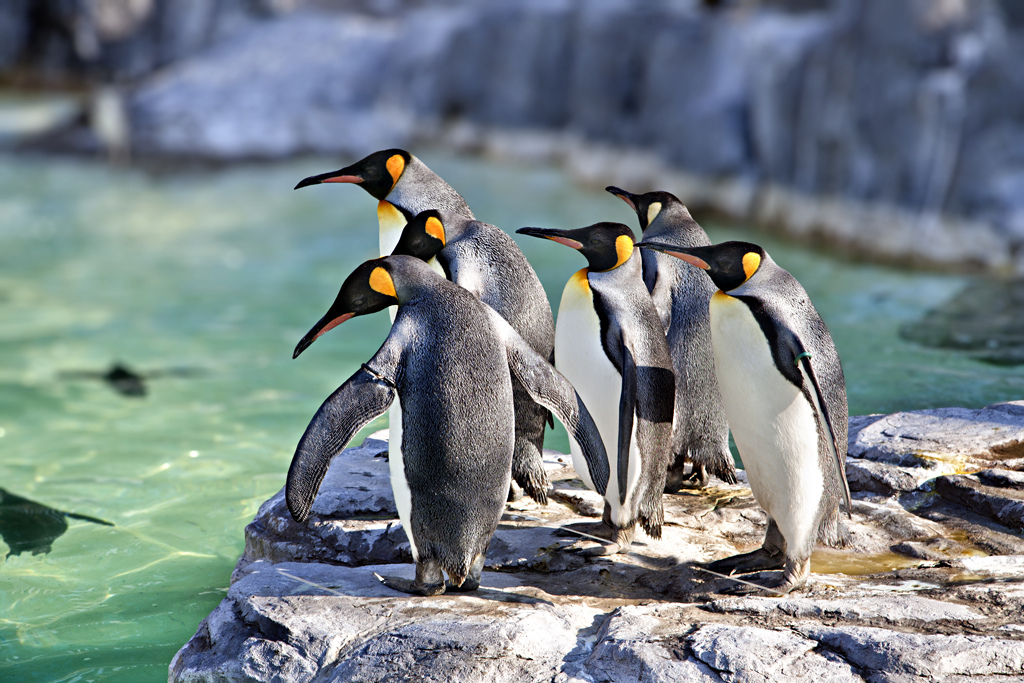 |
| A Parcel of Penguins |
http://commons.wikimedia.org/wiki/File:Group_of_Emperor_Penguins.jpg
http://commons.wikimedia.org/wiki/File:Schoolchildren_reading_1938.jpg
Monday, January 30, 2012
Being Batty
One of our Twitter followers asked this rhetorical question earlier today:
Logical. The Facts on File Encyclopedia of Word and Phrase Origins had a little more to add:
bat. (2010). In The Hutchinson Unabridged Encyclopedia with Atlas and Weather guide. Retrieved from http://www.credoreference.com/entry/heliconhe/bat
Hendrick, Robert. The Facts on File Encyclopedia of Word and Phrase Origins. New York, NY: Facts on File, 1997. Print.
 |
| Bats emerging from Carlsbad Caverns, NM |
Why do they say bat out of hell? I'd think a bat would be trying to get to hell. I bet hell is bat heaven.Now, he may have been listening to too much Meatloaf, but I'm not one to pass up a good question. I do so enjoy phrase etymology! Luckily, we have oodles of books on the subject. According to Dictionary of Animal Words and Phrases, this is the meaning for like a bat out of hell:
The bat, being a nocturnal animal, is associated with darkness. Therefore, in the folklore of many parts of the world, it is said that the devil, the Prince of Darkness, often takes the form of a bat. In fact, the devil is often depicted with bat's wings. Bats are also generally associated with caves, which look like routes to hell, the devil's habitat. Bats are also noted for their quick, darting flight. All of these associations have come together in a twentieth-century expression: to go very quickly is to go like a bat out of hell.
(Lyman 23)
Logical. The Facts on File Encyclopedia of Word and Phrase Origins had a little more to add:
Since bats are nocturnal creatures that loathe the light, the hellfires of the infernal regions would inspire them to flap like hell to get out of there. That may be the idea behind the expression to move like a bat out of hell, extremely fast, which Partridge traces to 1908 and which probably goes back to the late 19th century. It was also slang used by R.A.F. pilots since World War I for "to fly extremely fast."
(Hendrickson 55)
I did find that bats that live in temperate climates hibernate during the winter (Hutchinson). I suppose they might like the warmth of hell, if not the light.
bat. (2010). In The Hutchinson Unabridged Encyclopedia with Atlas and Weather guide. Retrieved from http://www.credoreference.com/entry/heliconhe/bat
Hendrick, Robert. The Facts on File Encyclopedia of Word and Phrase Origins. New York, NY: Facts on File, 1997. Print.

Lyman, Darryl. Dictionary of Animal Words and Phrases. Middle Village, NY: Jonathan David Publishers, Inc., 1994. Print.
Tuesday, April 19, 2011
The Plight of the Platypodes
I jokingly e-mailed this GIF to some of my friends and mentioned that I would like to receive a platypus for my birthday. (My birthday isn't for three months. I like to start throwing gift ideas out early.)

http://icanhascheezburger.com/2011/04/12/funny-pictures-gifs-platypus-prowl/
One of my friends, the big goof, wanted to know if it were actually possible to own a platypus. Well, I didn't know, but I do now!
Tom R. Grant "Platypus" The Encyclopedia of Mammals. Ed. David W. Macdonald. Oxford University Press, 2007. Oxford Reference Online. Oxford University Press. Mississippi Library Commission. 13 April 2011 http://www.oxfordreference.com/views/ENTRY.html?subview=Main&entry=t227.e111
http://icanhascheezburger.com/2011/04/12/funny-pictures-gifs-platypus-prowl/
One of my friends, the big goof, wanted to know if it were actually possible to own a platypus. Well, I didn't know, but I do now!
Platypus are wild animals with specialised living requirements. It is illegal for members of the public to keep them in captivity. A platypus which has been accidently captured along a stream or found wandering in an unusual place should never be taken home and treated as a pet, even for a brief time. The animal will not survive the experience.My dream is dashed. Not only wouldn't they survive in captivity (I'm not sure how well they would adapt to my cats, either,) but they also have some disturbing habits. Did you know:
Only a small number of Australian zoos and universities hold permits to maintain platypus in captivity for legitimate display or research purposes. Current Australian government policy does not allow this species to be taken overseas for any reason. http://www.platypus.asn.au/distribution_and_status.html
- Every male platypus has a venemous spur on each of his back ankles. This venom is extremely painful to humans and also causes inflammation and swelling (Oxford Reference).
- The female does not have teats. Instead of suckling, the young lap up milk secreted by skin on the mother's stomach (Oxford Reference).
Tom R. Grant "Platypus" The Encyclopedia of Mammals. Ed. David W. Macdonald. Oxford University Press, 2007. Oxford Reference Online. Oxford University Press. Mississippi Library Commission. 13 April 2011 http://www.oxfordreference.com/views/ENTRY.html?subview=Main&entry=t227.e111
Monday, July 19, 2010
Don't Be Didine!
This blog post originally appeared 2/28/2008.
We all know that "canine" means dog and "feline" means cat, but did you know the rest of these animal adjectives?
Ant: myrmicine
Armadillo: dasypodid
Crocodile: eusuchian
Dodo: didine
Duck: anatine
Duck-billed platypus: monotremal
Flea: pulicine
Flamingo: phoenicopterous
Goat: caprine
Goose: anserine
Louse: pedicular
Mite, tick: acarian
I am going to have to try hard to manage to work in some of these into my everyday vocabulary. Let's see:
He took a phoenicopterous stance while playing hopscotch.
Don't be didine! Of course I love this blog.
That is the lowest, most pedicular thing you have ever done.
Feel free to leave your own adjective-filled comments if you get the urge.
Source: Schott's Almanac 2008 Page-a-Day calendar; Thursday, February 28.
We all know that "canine" means dog and "feline" means cat, but did you know the rest of these animal adjectives?
Ant: myrmicine
Armadillo: dasypodid
Crocodile: eusuchian
Dodo: didine
Duck: anatine
Duck-billed platypus: monotremal
Flea: pulicine
Flamingo: phoenicopterous
Goat: caprine
Goose: anserine
Louse: pedicular
Mite, tick: acarian
I am going to have to try hard to manage to work in some of these into my everyday vocabulary. Let's see:
He took a phoenicopterous stance while playing hopscotch.
Don't be didine! Of course I love this blog.
That is the lowest, most pedicular thing you have ever done.
Feel free to leave your own adjective-filled comments if you get the urge.
Source: Schott's Almanac 2008 Page-a-Day calendar; Thursday, February 28.
Subscribe to:
Posts (Atom)
