Have you ever wanted to learn more about your town? Do you like gossip and facts about trees? You need to check out the WPA files! WPA stands for Works Progress Administration, which was organized as part of the New Deal to provide jobs for unemployed Americans during the Great Depression. One of the projects of the WPA was to gather local histories by going into each county, interviewing the residents, and compiling research. MLC has files for all of Mississippi’s counties except for Sharkey and Wilkinson. The source material for these files can be found at the Mississippi Department of Archives and History.
Have a question?
Chat Monday-Friday, 8 AM - 5 PM (except MS state holidays)
Phone: 601-432-4492 or Toll free: 1-877-KWIK-REF (1-877-594-5733)
Text: 601-208-0868
Email: mlcref@mlc.lib.ms.us
Wednesday, March 27, 2024
Monday, May 30, 2022
Reel Scary: MLC’s Microfilm Readers
This machine works by projecting images stored on microfilm and then magnifying them so that they become readable. The machine is paired with software that allows one to manipulate the projected image in order to better view its contents. For example, there are ways to correct film that appears upside down or backwards. One can also crop out extraneous information from a web capture. MLC’s microfilm software, ViewScan 4T, even allows patrons printing and saving options so that they can have a copy of the information they’ve located once they leave. Sound overwhelming? Don’t worry. This software includes a short tutorial video that covers how to use each of these features.
Despite these useful features, patrons often shy away from the microfilm reader as if it were a red eyed monster with pointy teeth. At one point, MLC’s patrons were justified in feeling this way. See, just as recently as this past January, the Commission was battling a menacing machine that seemed to be guided by otherworldly hands. While I did not experience these creepy happenings personally, I’ve heard whispers from those who did. Alex Brower, Information Services Director, explains how the machine would “screech” when in use and, “At the very end, it had trouble working, the light would come on under the plate but the actual camera wouldn’t show anything.” She also shares how she is “so much happier with the new machines,” because, “they are so fancy!” I think we all know that the word “fancy” here actually means not haunted.
And how great for researchers that these new machines are much nicer! Before the switch, many patrons were missing the sense of reward that follows locating obscure yet helpful information. For instance, some patrons have found useful information they could not access elsewhere regarding loved ones via our microfilm reader. The sources in our collection also have the potential to help researchers with questions about notable local events and legends. For instance, many people might be unaware of Mississippi’s brief brush with extraterrestrials. However, one event often referred to as the 1973 Pascagoula Alien Abduction made national headlines, and MLC’s microfilm collection contains an article from the Clarion-Ledger covering the infamous happenings. See the image below:
Perhaps local legends are not your thing? No worries! Patrons are welcome to view their own microfilm reels on these machines. Currently, there is no limit to how many reels patrons can bring and view at MLC. I hope more patrons will use this handy resource more often.
***Note*** While we promise that the new microfilm reader doesn’t bite, we make no such promise for the information it unwinds.
Friday, October 2, 2020
A Letter from Your Friendly MLC Archivist
Dear Reader,
This is the first in a series of letters I will be writing to you from time to time as I gleefully work my way through the hidden treasures of the MLC archives. I will be sharing interesting items, stories about the history of MLC, and any other interesting tidbits I may find on this “curiosity voyage.” First, I want to share with you a personal story about my first experience working in an archive, an experience which solidified my love for historic preservation and archival management. It’s a story of human connection found unexpectedly beneath a pile of yellowed papers.
Enjoy.
I’ll never forget the first time I cried in a library. No, I wasn’t reading a Nicolas Sparks book or doing my taxes. I was reading a letter from William J. Love, a WWI veteran and businessman from Columbus, MS. This letter was addressed to his friend and business partner and was written the year before he passed away. I discovered this letter after spending several months going through boxes of Love’s belongings – mostly letters, scrapbooks, some photographs, and business documents. Although he had been dead for over 40 years, I felt like I had come to know him while organizing the belongings he left behind. I had read multiple letters like this one, but somehow, this one seemed very final. His health was declining. I knew he would die the following year. Maybe he knew it too.
So I cried.
It was an unexpected side effect that sometimes comes with archival work. If you’ve ever worked in an archive, or if your library has its own local history department, you are probably familiar with the situation I described. A patron goes through their recently deceased relative’s attic. They bring in half-chewed boxes of documents and photos to donate to your collection. You quickly leaf through the items to get an idea of what is in them (and check for any varmints that may be hiding between the pages). Then, you add the boxes to the stack of other boxes from other deceased relatives that you hope to finish processing before the year is out. Or the decade. Or maybe just before you retire.
![]() |
| Photo of slides from the William J. Love Papers in the Billups-Garth Archive, Columbus Lowndes Public Library |
The process can become very monotonous very quickly.
Archivists bear a lot of responsibility when it comes to processing collections, especially those collections that come from private donations. Not only is it the job of the archivist to analyze every item that comes into their possession, organize boxes of materials, and create extremely detailed, searchable records of the items, but they are also responsible for taking proper care of belongings that have sentimental value to loved ones. For many private donors, an archive is the final resting place of a life that they cherished. For this reason, archivists have the responsibility of maintaining a sense of reverence when processing and preserving historical records.
It is easy to get caught up in the pressures of time constraints, cataloging and copyright issues, etc. and miss the opportunity to get to know the person(s) behind the collection. Archivists have a unique opportunity that goes beyond removing rusty paperclips and translating sloppy cursive. I like to tell people that I’ll never know what it’s like to cure cancer or invent some new technology that changes the world, but I do know what it’s like to see the look of pure joy on the face of the only daughter of a WWI veteran in Columbus, MS after I finished processing her father’s papers, allowing generations of researchers the opportunity to get to know her father the way I did.
Some would call it closure. Maybe a sense of peace. I like to think of it as another special service offered free of charge at your local library.
All the best,
Your friendly MLC archivist
P.S. If you are antsy with anticipation for my next letter, feel free to check out the MLC photograph collection made available through the Mississippi Digital Library.
Friday, June 19, 2020
The Name’s Squatch. Sassy Squatch.
The existence of the Sasquatch has been the source of many arguments, both familial and scientific. There have been videos of reported sightings, adamant campers with tall tales, and even college courses that debate or seemingly prove the existence (or not) of this creature. What does the Sasquatch have to do with libraries, one may ask? One daring investigator led the children of an afterschool program on a quest through admittedly fake (or are they?) primary source documents to learn the value of research.
![]() |
| Tracy Carr, Sasquatch Specialist (left) Sassy, Sasquatch Puppet (right) |
It all started when Tracy Carr, a librarian purportedly specializing in Sasquatches and real-life MLC Library Services Director, was invited to speak at the Neshoba County Library’s Sasquatch Week. A variety of “experts” presented information about various aspects of ‘Squatch life. At the end of each presentation, the adventurous attendees were polled to see who had been swayed towards believing in the beast. Ms. Carr needed to find a way to trick children and teach information literacy, but how?!
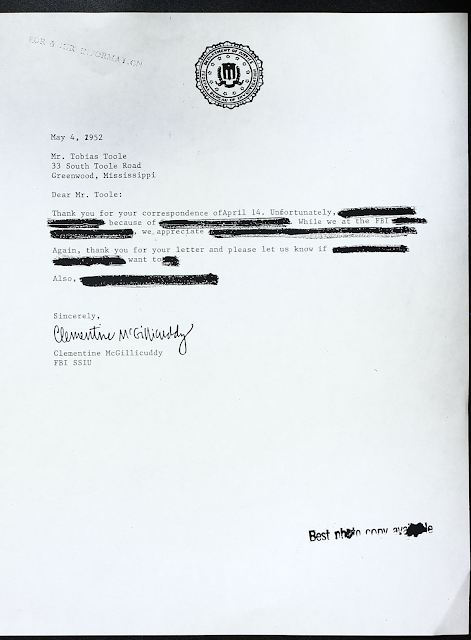
Enter Clementine McGillicuddy, Tobias Toole, and the mysterious Carl. These characters featured in four “primary source documents” that detailed the civilian Mr. Toole’s encounter with Carl, a suspected Sasquatch. Ms. McGillicuddy, an FBI agent from the Special Secret Issues Unit, made a sharpish safari to the Greenwood, Mississippi, site, ruining a presumably precious pair of pumps.
The ‘Squatch-seeking schoolchildren were instructed on the difference between primary and secondary sources. For those not in the know, or in the Special Secret Issues Unit, a primary source document is anything created at the time an event occurred. Examples include letters, diaries, newspaper stories, and photographs. Secondary sources are interpretations of primary source documents, like books written using diaries from the Civil War or a textbook written using interpretations of original research.
They were then presented with Ms. Carr’s “primary source documents”: three letters, one including a handy map, and a memo from the Special Secret Issues Unit. The children were tasked with putting them in order and discovering what events took place during the fateful days between February 3rd and May 4th, 1952. (These documents are included at the end of the post). The tale includes Mr. Toole’s original sighting and letter to Ms. McGillicuddy, hints at what may have been seen, and exposes the coverup that keeps Carl from certain discovery. After the students put the pieces together, Tracy had turned two doubting Thomases into totally taken-in Thomases. The investigators also got to make their own Sasquatch puppets.
![]() |
| Sassy the Sasquatch finger puppet conducting their own independent research. |
Primary Source Documents:
![]() |
| Letter from Tobias Toole to Clementine McGillicuddy |
![]() |
| Map from Tobias Toole, included in letter |
![]() |
| Memo from Clementine McGillicuddy to J.B. Simo |
![]() |
| Letter from Tobias Toole to Clementine McGillicuddy |
![]() |
| Redacted letter from Clementine McGillicuddy to Tobias Toole |
- Library of Congress Digital Collections
- Library of Congress’ primary documents sets (broken down by topic)
- Newspaper Source: Full text for 28 U.S. and international newspapers and more than 260 regional newspapers. In addition, full text television and radio news transcripts are provided from ABC, CBS News, CNN, Fox News, NPR, and more. Available through MAGNOLIA. Contact your library for your MAGNOLIA access code.
Interested in learning more about the Sasquatch and the lengths people have gone to find it? Check out these:
- Wild Thing (Podcast; may not be appropriate for children)
- Sasquatch Chronicles (Podcast; may not be appropriate for children)
- List of Sasquatch-Related Resources from Western Washington University
- Article from Smithsonian Magazine
Monday, June 11, 2018
Wisdom Teeth, Genealogy, and the World Cup
As luck would have it, the main show on TV was coverage of the FIFA World Cup and the miracle of this quadrennial world championship was that the Irish National Team made it to the finals. I was enthralled by the world’s enthusiasm for the sport and was consumed by “Irish Pride”. Team Ireland played their hearts out and Sheedy, a mid-fielder for Ireland, was my favorite. I became a soccer fan that summer.
| The official song of the Republic of Ireland’s National Football Team for the 1990 World Cup. |
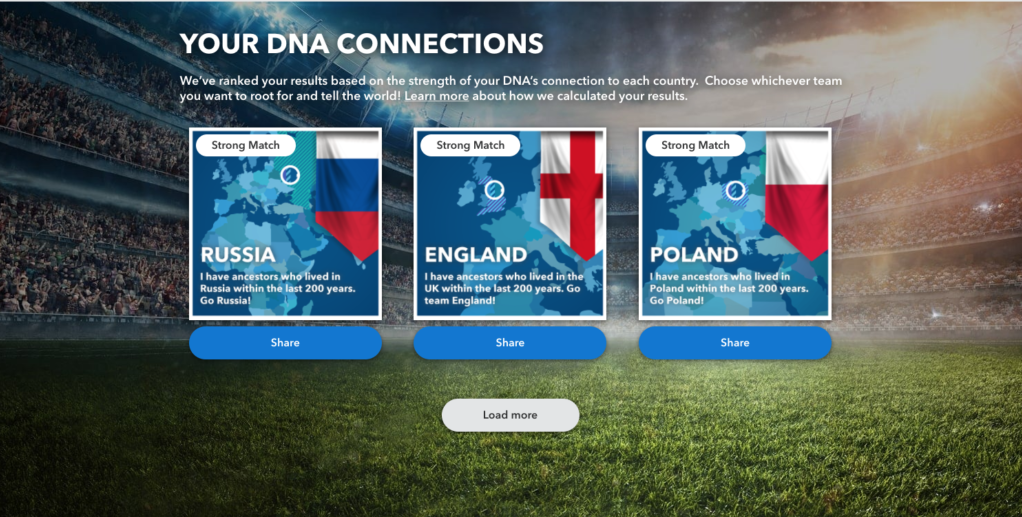
Speed forward to 2018. The United States National Men's Team (USNMT) failed to make it to the finals of the World Cup. For a lot of American fans, that was it. Who should we root for now? It was USA or go home.
![]() |
| 23 and Me Ancestry Composition |
Further, if you feel like a lone soccer fan, I would encourage you to look for your local American Outlaws chapter. Their mission is to “To support the United States National Soccer Teams through a unified and dedicated group of supporters. Creating a community locally and nationally to Unite and Strengthen U.S. Soccer fans from all parts of this country.”There are currently three chapters in Mississippi.
For a full list of countries competing in this year's World Cup, visit the FIFA website.
Finally, for help with genealogy research, visit the Mississippi Library Commission! You'll have complete access to Ancestry Library Edition here in the building. Better yet, while you're here you can sign up for an MLC library card. Those with MLC library cards can access Heritage Quest from the comfort of their own homes. Either way, our reference librarians would be glad to help you get started tracing your family tree!
Kristina Kelly
Administrative Services Administrative Assistant
Tuesday, February 3, 2015
Celebrating Black History Month @ Your Library
If you're looking for print resources on African-Americans, the Mississippi Library Commission is the place for you. Here are some of our favorites:
Black Heroes
Jessie Carney Smith
This book contains profiles of many African Americans, both well-known and obscure.
Q. Civil rights activist James Howard Meredith integrated the University of Mississippi on October 1, 1962. What was his name at birth?
A. "Moses 'Cap' Meredith named his son J. H. Meredith to prevent whites from calling him simply by his first name" (468).
African American Firsts: Famous, Little-Known and Unsung Triumphs of Blacks in America
Joan Potter
This text offers a plethora of Black firsts sure to intrigue any history buff.
Q. Who created the first golf tee?
A. "In December 1899, Dr. George F. Grant, an African-American dentist and an amateur golfer, received a patent for a wooden golf tee. Before his invention, golfers had to balance their balls on mounds of damp sand" (341).
African-American Holidays, Festivals, and Celebrations: The History, Customs, and Symbols Associated with Both Traditional and Contemporary Religious and Secular Events Observed by Americans of African Descent
Kathlyn Gay
This resource outlines all of the holidays, festivals, societies, and events with African-American themes.
Q. What was the first black sorority?
A. Alpha Kappa Alpha, "the first black sorority was formed in 1908 by nine women at Howard University in Washington, D. C." (189).
African American Almanac: 400 Years of Triumph, Courage and Excellence
Lean'tin Bracks
Here is another compilation of short biographies. It also includes sections on African-American history.
Q. Who was the first black woman bishop in any of the large American denominations?
A. Leontine T. C. Kelly, born in Washington, D. C. in 1920, was elected a bishop in the United Methodist Church in 1984 (126).
We'll be posting more information about Black History Month and the achievements of African-Americans over the next month. If you can't wait for more tidbits, check out this website, which provides audio/video files, images, and lesson plans on the topic, as well as great information on historical events.
Friday, June 21, 2013
Genealogy Tips! - Part 2
Most people generally have a specific person(s) of interest that they would like to research. They may have this person’s full name, place of birth, and other potentially useful information ready at hand. The information is plugged in to the particular database and…nothing. You go back and simplify or elaborate on your query. Still, nothing. You try over and over…yet nothing. There must be some record of this person! Why aren’t they appearing?
Tuesday, April 23, 2013
Genealogy Tips - Part 1
Genealogy research is a lot like a treasure hunt. It can be very fun and rewarding to unearth family information, but it can also be potentially frustrating if you don't have as many facts as possible on hand to get you started on the right track. Because of this, we here at MLC thought it would be a great idea to share a few helpful links, book titles, and tips we've learned along the way while assisting our patrons with genealogy research. So here goes!
Tip #1- Organization is key! You may find a little bit, or a lot, but having a well-organized accordion file folder, or a three ring binder (or whatever works best for you) will save you in lost time and headaches. Everything you need will be right on hand.Tip #2- Gather as much information as possible! Interview relatives, obtain copies of vital records (birth certificates, marriage certificates, death certificates, etc.) and plot out a general family tree (or ancestral chart) using what you already know (or gathered through interviews with relatives). There will be exceptions to this rule. Sometimes the impetus for starting genealogy research is because there's not much family information available to begin with. That's okay! Gather as much information as you can and try to fill in the gaps as you go along. Please feel free to contact us if you need assistance.
Tip #3- Take your time and enjoy the process! It's perfectly fine to take a step back if you hit a bump in the road, or if life happens and you can't devote as much time as you'd like to the whole process.
Helpful Links:
Getting Started - National Genealogical Society
Organization for Genealogists - About.com
Titles at MLC:
AARP Genealogy Online: Tech to Connect by Matthew L. Helm and April L. Helm. 2013
Genealogy Online for Dummies by Matthew L. Helm and April L. Helm. 2009
The Official Guide to Ancestry.com by George G. Morgan. 2008
Plugging Into Your Past: How to Find Family History Records Online by Rick Crume. 2004
...and many more!
Did you know that we have Ancestry Library Edition and Heritage Quest available for use on our premises? If you have a library card with us, you can access Heritage Quest at home. Contact us for more information!
.png)
.png)
.png)