JavaScript disabled or chat unavailable.

Have a question?

We have answers!
Chat Monday-Friday, 8 AM - 5 PM (except MS state holidays)
Phone: 601-432-4492 or Toll free: 1-877-KWIK-REF (1-877-594-5733)
Text: 601-208-0868
Email: mlcref@mlc.lib.ms.us
Showing posts with label inventions. Show all posts

Friday, February 6, 2015

Eureka!

We're back with our celebration of Black History Month! This time, we're focusing on African American scientists and inventors.

Did you know that Rebecca Lee Crumpler was the first African American female physician? She graduated from the New England Female Medical College in 1864 (92). Dr. Roger Arliner Young was "the first African American woman to conduct and publish research in her field." A zoologist, she wrote a paper entitled On the Excretory Apparatus in Paramecium in 1924 (37). You can read more about these and other black female scientists in Black Stars: African American Women Scientists and Inventors.

 African American Women Inventors 1884-2003 shares patents from black female inventors.These inventions span a range of beauty supplies and instruments, to medical tools and equipment, to toys and games. For example, in 1951, Bessie Virginia Griffin was granted a patent on a device that allowed people with temporary or permanent disabilities to drink from a cup or bowl.
Another personal favorite of mine? Deanna R. Meredith was issued a patent in 1984 for an extendable skateboard.
Now that is totally gnarly, dude!


Black Stars: African American Inventors details the lives of numerous black inventors. Included are astronaut Guion S. Bluford, the first African American in space (139) and Dr. Daniel Hale Williams, a brilliant surgeon who opened the first non-segregated hospital in the United States (52).

Want to learn even more about black scientists? Check out this two volume set that covers everyone from George Washington Carver, a botanist who focused on peanuts and peanut products (37), to Clarence Arthur Ellis, the first African American PhD in computer sciences (69), to Neil deGrasse Tyson, astrophysicist (194). African Americans in Science educates us about them all.

Be sure to stop by the Mississippi Library Commission to check out these and many, many other books on the myriad accomplishments of African Americans in the sciences. Happy Black History Month!

Friday, March 23, 2012

Permanent Waves Guaranteed!

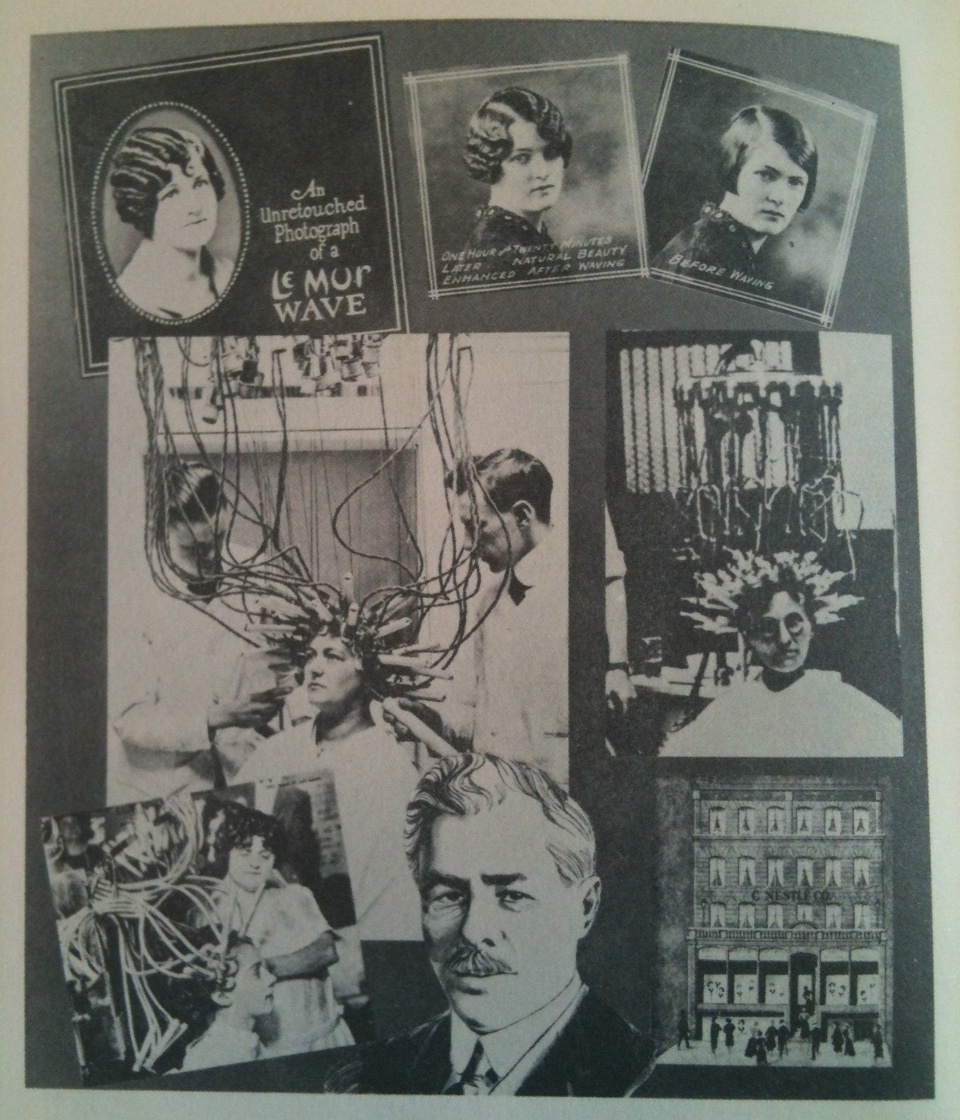
The business of hair has been around for centuries from elaborate updos to stylish bouffants.  In Hannah Campbell's Why Did They Name It...? we learn the story of a skilled stylist, Charles Nestle (born Karl Ludwig Nessler), who was fixated for years on the idea of creating a product that would imbue women's hair with permanent waves.  After much trial and error he came up with an elaborate machine that looks a lot like a contraption for torture:

 When the inventor of the permanent waving machine, Charles Nestle, advertised the opening of his salon in New York, sixty-two women responded.  Sixty-one walked away without the permanent—frightened either by the waving apparatus itself (although it was guaranteed shock-proof) or the price.  But one woman stayed and this was the beginning of Nestle’s American success.  By 1919 a Nestle permanent was part of many women’s beauty regimen” (Campbell, following page 112).

Would you have been brave enough to stay (and pay) for this experiement on your hair, or politely decline?  Another option would've been to say to the woman behind you, "You go first!"

This process took nearly ten hours using harsh chemicals to break the bonds on the hair as it was rolled onto hot cylindrical hair rollers (electrical currents were not predictable in the 1900s) and then the hair was oxidized to maintain the newly formed curls.  This often caused hair breakage which coined the term "pocket perm" because the hairstylists would quickly tuck the broken pieces of hair in their pockets before the clients viewed their final style (Sherrow 303).

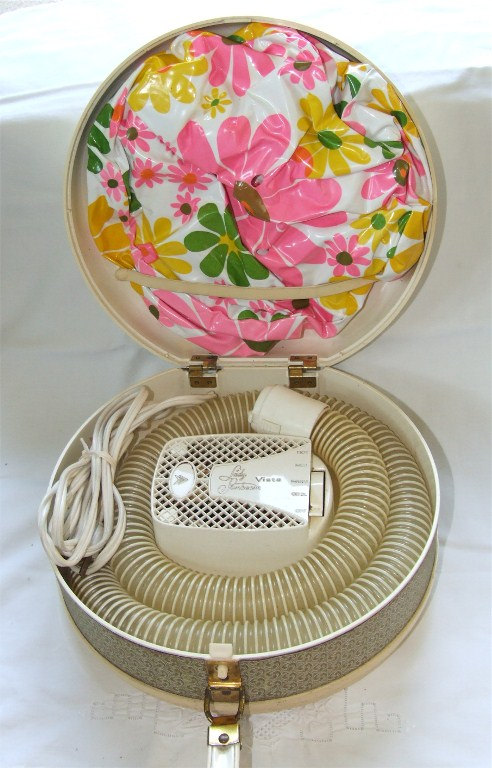
My colleague, Elisabeth, told me about a bonnet hair dryer bestowed onto her by her mother.  This contraption from the 1960s did not involve chemicals, but instead involved placing a nylon-like bag (bonnet) over your head with a hole in some vicinity around the bonnet just big enough for the tube attachment.  There was no place for the water to escape, and your hair line received a nice, itchy indentation from the bonnet's elastic rim upon finishing.  It looked a lot like this Lady Sunbeam bonnet hair dyer:


At least it was portable, and hopefully shock-proof!

Campbell, Hannah. Why Did They Name It…?. New York, NY: Fleet Publishing Corporation, 1964. Print.
Sherrow, Victoria.  Encyclopedia of Hair: A Cultural History. Westport, CT: Greenwood Press, 2006. Print.

Thursday, November 4, 2010

There's Only One "S" In Saving

OK, y'all. It appears that for my entire life I have been suffering from the misconception that there is such a thing as Daylight Savings Time. Well, that just isn't so. The correct name for the devilment that occurs yet again this weekend is Daylight Saving Time--no extra "s." While you try to remember where you put the directions on how to change the clock on your car radio, let me fill you in on a few other DST nuggets.
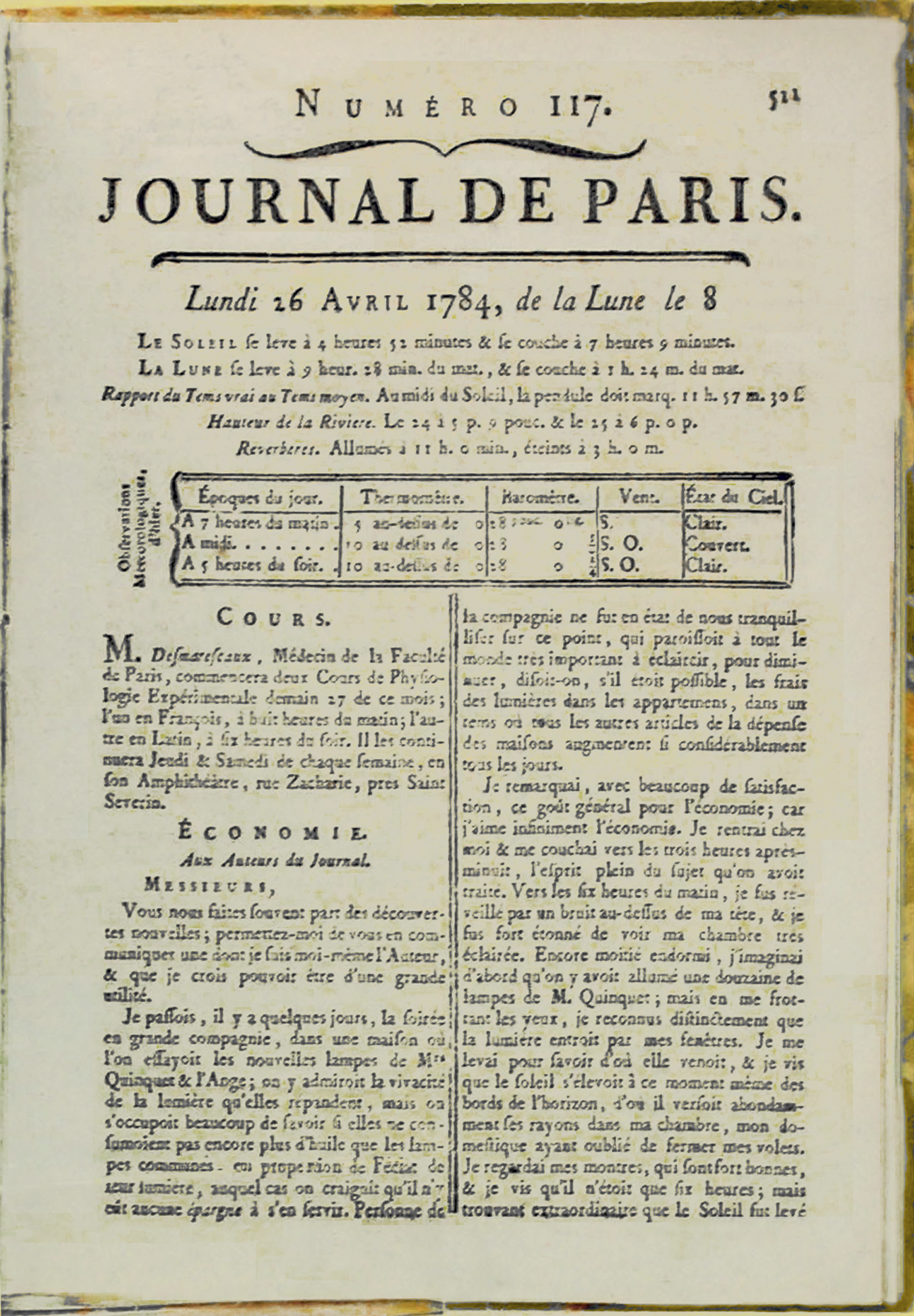
  • You remember Benjamin Franklin? Funny hair, glasses, one of the founding fathers of our country, invented things? Franklin penned an article that proposed “earlier opening and closing of shops to save the cost of lighting" while he was the American minister to France (Columbia).
  • Every spring and fall I try to remember when the big dates are. Every spring and every fall I can't remember without asking at least 20 other people who, guess what!, can't remember either. Here it is:

          I'm sure we could come up with an easy mnemonic to remember this... Tracy suggests starting with "The first Sunday of November is the day I can't remember." A gold star to whomever can find a good rhyme line for March!
  • If you venture forth to western Europe, you'll probably find that Daylight Saving Time starts the last Sunday of March and ends the last Sunday of October (Britannica). I am at a loss to explain why we can come up with standard time zones, but not a standard for saving time.
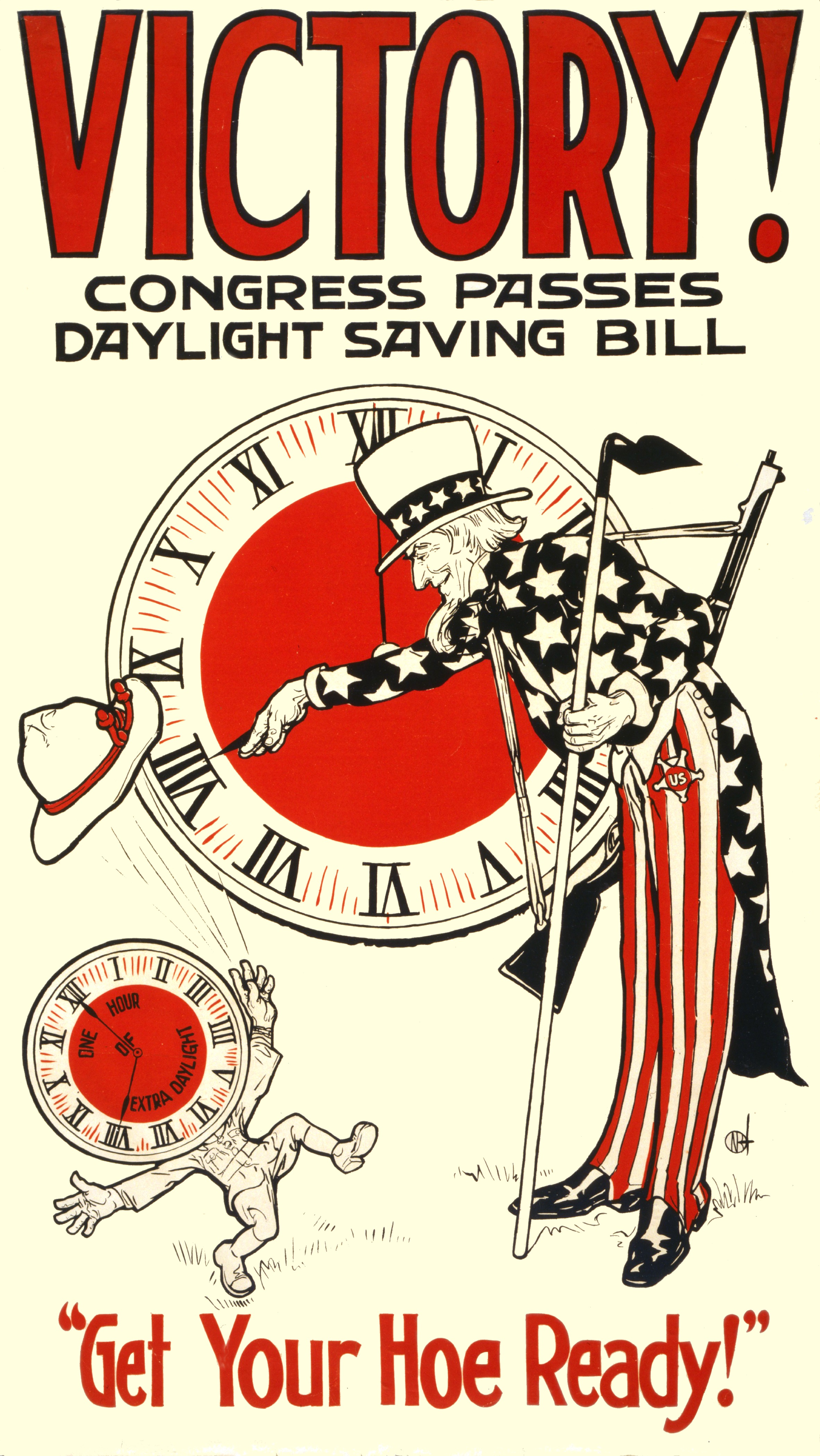
  • Daylight saving time was first attempted in modern times as a cost-saving method during war. The Germans, British, and Americans, among others, adopted this practice during WWI.
  • Americans also used Daylight Saving Time during WWII and the energy crisis of 1973-74, with many cities and states keeping a version of DST at other times while the rest of the country was not. All states except Arizona and Hawaii now follow the federal standard for DST (Columbia).
By the way, I haven't changed my car radio's clock for years. I gleefully ride about with reckless abandon for eight months of the year with the wrong time. I sure am glad I can't get a ticket for that! You try to be a bit more careful with time than me, and don't forget:

Spring Forward! Fall Back!

And you'll be fine!

Britannica Concise Encyclopedia. Chicago: Encyclopaedia Britannica, 2009. Credo Reference. Web. 03 November 2010.
"daylight saving time." The Columbia Encyclopedia. New York: Columbia University Press, 2008. Credo Reference. Web. 03 November 2010.
http://commons.wikimedia.org/wiki/File:Franklin-Benjamin-Journal-de-Paris-1784.png
http://commons.wikimedia.org/wiki/File:Victory-Cigar-Congress-Passes-DST.jpeg

Friday, November 21, 2008

Take a Seat.

Did you know that MLC is the only Patent and Trademark Depository Library in Mississippi? If you have a great idea for a new product or need to trademark your brand name or slogan, you can call us for assistance.
I was going to provide you a list of various Mississippi inventors and their inventions, but unfortunately most of them are super scientific and are way above my head (silicon carbide semi-insulating epitaxy layer, anyone?). However, there is one recent invention that is definitely not, er, above my head at all. From the Laurel Leader-Call:

Local man invents vibrating toilet seat
By Eloria Newell James
A Jones County native has developed a new twist to a traditional item. Johnny Henry of Laurel has developed the vibrating toilet seat.
“I believe in thinking out of the box,” Henry said. “I wanted to create something that is a little unusual.
“This invention is designed to stimulate,” he said. “It’s to make you feel good while you are there.”
Because of Henry’s invention, he recently attended the Invent Bay International Inventors Convention held at the Sands Hotel in Las Vegas, Nevada.
“It was great,” Henry said about the convention. “You get to meet with licensers, buyers and investors, and I got a chance to promote my product. ... It was really nice.”
Also while at the convention, Henry, a native of Soso, made a pitch for the Jay Leno Show and The Discovery Channel. Henry said he currently has a provisional patent on the product, however, “hopefully I’ll get on one of the shows and be able to introduce my product to a national audience.” Henry said the vibrating toilet seat “is a novelty item that can also be used as a gag gift.”
When asked how he developed the idea, Henry said he “wanted to add
some life to the otherwise lifeless toilet seat.”
Henry, a 1968 graduate of Roosevelt High School in Ellisville, attended Jones County Junior College and Alcorn State University before entering the United States Army in 1973. After three years in the Army, Henry enrolled at the University of Southern
Mississippi, where he obtained a bachelor’s degree in sociology. However, Henry said the inventors convention was very educational.
“The convention was very exciting. There was 300-400 investors there,” Henry added. “I gained a wealth of knowledge about how to market inventions and how to get a product going.”
Henry, who began working on his invention in 1997, has now developed a prototype. Henry said he continues to work on the invention to make it look more slick, modern and appealing.
“I want it to automatically turn on when someone sits on the seat,” he explained. “It will have two speeds. On high speed, it will increase the blood flow and stimulate the body and muscles.”
Henry, who enjoys writing, said he has gotten poems published and
also a book. However, Henry said, he continues to be focused on modernizing his invention.
For more information about Henry’s invention, you can contact the inventor at 601-729-4470.
Related Posts Plugin for WordPress, Blogger...