JavaScript disabled or chat unavailable.

Have a question?

We have answers!
Chat Monday-Friday, 8 AM - 5 PM (except MS state holidays)
Phone: 601-432-4492 or Toll free: 1-877-KWIK-REF (1-877-594-5733)
Text: 601-208-0868
Email: mlcref@mlc.lib.ms.us
Showing posts with label medicine. Show all posts

Friday, February 6, 2015

Eureka!

We're back with our celebration of Black History Month! This time, we're focusing on African American scientists and inventors.

Did you know that Rebecca Lee Crumpler was the first African American female physician? She graduated from the New England Female Medical College in 1864 (92). Dr. Roger Arliner Young was "the first African American woman to conduct and publish research in her field." A zoologist, she wrote a paper entitled On the Excretory Apparatus in Paramecium in 1924 (37). You can read more about these and other black female scientists in Black Stars: African American Women Scientists and Inventors.

 African American Women Inventors 1884-2003 shares patents from black female inventors.These inventions span a range of beauty supplies and instruments, to medical tools and equipment, to toys and games. For example, in 1951, Bessie Virginia Griffin was granted a patent on a device that allowed people with temporary or permanent disabilities to drink from a cup or bowl.
Another personal favorite of mine? Deanna R. Meredith was issued a patent in 1984 for an extendable skateboard.
Now that is totally gnarly, dude!


Black Stars: African American Inventors details the lives of numerous black inventors. Included are astronaut Guion S. Bluford, the first African American in space (139) and Dr. Daniel Hale Williams, a brilliant surgeon who opened the first non-segregated hospital in the United States (52).

Want to learn even more about black scientists? Check out this two volume set that covers everyone from George Washington Carver, a botanist who focused on peanuts and peanut products (37), to Clarence Arthur Ellis, the first African American PhD in computer sciences (69), to Neil deGrasse Tyson, astrophysicist (194). African Americans in Science educates us about them all.

Be sure to stop by the Mississippi Library Commission to check out these and many, many other books on the myriad accomplishments of African Americans in the sciences. Happy Black History Month!

Friday, September 12, 2014

Cures, Maybe?

Did you know? Eating five almonds before partying hard will guard against total inebriation and hangovers. Sounds pretty nifty, right? As scientific and medical research have progressed over the years, we  have come to dismiss such bold claims. Back in the 1400s and 1500s, however, people believed such professions, and they were held widely as fact. I've been exploring a book I found in the Mississippi Library Commission's collection called Folklore and Odysseys of Food and Medicinal Plants and having a wonderful time. Wouldn't it be delightful if some of the herbs and plants covered actually did what people thought they did, way back when?

  • Caraway seeds were the early Renaissance's precursor to Rogaine. Pop some of these babies, and hello luxurious head of hair a la Fabio. Nowadays, you'll find caraway seeds flavoring some Havarti cheeses and rye breads.
    Fabio, with a healthy mane
  • If caraway seeds were the Rogaine of the 15th century, then pepper was surely thought of as a wonder drug like penicillin. People thought pepper could cure toothaches and prevent the Bubonic Plague, among many other maladies and diseases. In modern times, many people like using it to flavor eggs. What an embarrassing descent.
    Would you like some eggs with your pepper?
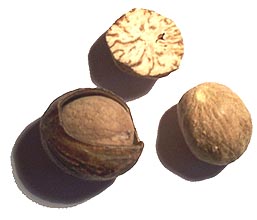
  • If you use your imagination, nutmeg sort of looks like mini-brains. Naturally, people of the Renaissance used them to cure a variety of brain problems. And poor eyesight. I suppose because of the brain and eyes close proximity to each other, it's a semi-logical jump. I like to use nutmeg as a substitute for cinnamon because I have a slight cinnamon sensitivity. It's definitely tasty on French Toast! I don't think my eyesight is improving, though.
Nutmeg posing as brains

If you, too, have a penchant for the medicinal practices of yesteryear, stop by the Mississippi Library Commission and check out this book!

Lehner, Ernst and Johanna Lehner. Folklore and Odysseys of Food and Medicinal Plants. New York, New York: Tudor Publishing Company, 1962. Print. 
http://commons.wikimedia.org/wiki/Myristica_fragrans#mediaviewer/File:Muscade.jpg
http://commons.wikimedia.org/wiki/File:%E7%9B%AE%E7%8E%89%E7%84%BC%E3%81%8D.JPG
https://www.goodreads.com/book/show/891815.Defy_Not_the_Heart
Related Posts Plugin for WordPress, Blogger...