The holidays are here! It is a time for eating, spending time with family, and more eating. MLC's patrons have access to the CreativeBug database from home any time they want, and it is one of my favorite places to go to find fun art, craft, and food ideas. I was inspired by a program at the Carthage-Leake County Library where the Mississippi State Extension Service showed library patrons how to make charcuterie boards, so I wanted to share some Creativebug classes that have delicious recipes and holiday ideas to make you the host with the most!
Have a question?
Chat Monday-Friday, 8 AM - 5 PM (except MS state holidays)
Phone: 601-432-4492 or Toll free: 1-877-KWIK-REF (1-877-594-5733)
Text: 601-208-0868
Email: mlcref@mlc.lib.ms.us
Monday, December 11, 2023
Monday, November 20, 2023
Life Is What You Bake It...
...and so is cooking while blind or visually impaired.
People have this idea that you shouldn't touch anything in the kitchen because you're low vision or blind. They think you'll have a lot or accidents or get hurt or something. But accidents don't have much of anything to do with sight, and there are a lot of preventative measures you can take to be a competent low-vision or blind chef.
That's Margaret Smitherman, Patron Services Librarian with MLC's Talking Book Services. Margaret is a low vision cook herself. She says that one of her favorite cooking memories was receiving her grandmother's recipe for pound cake, which was intended to be made in a wood-burning stove. The recipe even had directions for picking the proper sized logs to use in the oven. It was printed in New York Point, an early form of dot system used by the blind. Margaret adapted the recipe for a modern oven and has made it multiple times over the years, most recently for an MLC holiday gathering. (I'm here to tell you, it's delicious.) Some of her favorite tips for cooking with low or no vision include using a whistling tea kettle, keeping a bowl of ice water on the counter for treating mild burns, and using your timer and your nose to know when food is done.
There are a lot of places out there with advice and pointers on how to get started cooking with a visual impairment. Here are a few places we found to get you started:
- This article from the American Printing House for the Blind gives some great tips for organization and prep work when cooking.
- The Blind Kitchen offers videos and recipes for those with low or no vision, with the added bonus of having adaptive equipment available to purchase from their store.
- Cooking without Looking is a fun YouTube channel that features blind and low vision people cooking and leading their lives. There's a podcast, too!
- This article from The Blind Guide has more excellent tips for cooking with low or no vision. The website was started when the author's mother lost her vision in the 1990s.
If you're in Mississippi, you couldn't ask for a better resource to get cooking in the kitchen than the Addie McBryde Rehabilitation Center for the Blind. A part of the Mississippi Department of Rehabilitation Services, they teach those with low or no vision how to cook on their own, imparting important skills like meal planning and preparation, grocery shopping, and kitchen organization. If you know someone who can benefit from this service, fill out their online form here.
Last but not least, don't forget about MLC's Talking Book Services! The service is available to all Mississippians who are unable to read standard print due to a visual, physical, or print disability. Their catalog offers hundreds of cookbooks and other books about cooking which can be accessed by downloading or requesting a hard copy on cartridge. Give them a call at 1-800-446-0892 if you have any questions or need help signing up for the service.
Thursday, June 14, 2018
Books and Bourbon
In honor of National Bourbon Day, June 14, we're exploring the history of bourbon and some writers who enjoyed drinking it.
| Our Faulkner bust with a couple of books from our collection. |
The history of alcohol, and more specifically bourbon, is an interesting one. While not America’s first distilled beverage--that would be rum--it is perhaps the most distinguished. It is often called bourbon whiskey, but please note that not all whiskey is bourbon but all bourbon is whiskey.
The criteria for a liquor to be called bourbon are as follows:
- Made in America
- Must be 51 percent corn
- Stored in new, not aged casks
- Distilled no more than 160 proof/barreled at 125 proof
This got me thinking about writers who were known to imbibe. Visit your local library to check them out and enjoy!
"I've been drinking beer most of the day, but don't worry, kid - I'm not gonna stick my fist through the window or bust up any furniture. I'm a pretty benign beer drinker...most of the time. It's the whiskey that gets me in trouble. When I'm drinking it around people, I tend to get silly or pugnacious or wild, which can cause problems. So when I drink it these days, I try to drink it alone. That's the sign of a good whiskey drinker anyway - drinking it by yourself shows a proper reverence for it. The stuff even makes the lampshades look different." Charles Bukowski
“You see, I usually write at night. I always keep my whiskey within reach; so many ideas that I can’t remember in the morning pop into my head.” William Faulkner, to his French translator Maurice Edgar Coindreau, Conversations with William Faulkner
“Enjoyed it? One more drink and I’d have been under the host.” Dorothy Parker in Try and Stop Me by Bennett Cerf
"All you have to do is drink a little whiskey, smoke a joint, eat some acid, and you too can write like this." Hunter S. Thompson, Conversations with Hunter S. Thompson
“I'm an occasional drinker, the kind of guy who goes out for a beer and wakes up in Singapore with a full beard.” Raymond Chandler, "The King in Yellow" Collected Stories
Kristina Kelly
Administrative Services Administrative Assistant
Wednesday, November 9, 2016
Pie? Or Cake? (Or Pie?) (Or Cake?)
Create your own user feedback survey
Wednesday, November 26, 2014
A Feast of All the Meats!
As you are preparing for your Thanksgiving meal, take a look at Major-General Philip Sheridan's troops' Thanksgiving "bill of fare" in 1868 during the Indian Wars as described by De B Randolph Keim in Menus from History: Historic Meals and Recipes for Every Day of the Year by Janet Clarkson.
What does any of this mean? We found out for you!
- Buffalo Hump - We'll save you the gory details of the process and just say it's the entire hump along the vertebrae of the bison (Clarkson, 602).

Buffalo/Bison - Saddle of Venison - Much like the buffalo hump, this is also a segmented area cut along the spine of a deer. "It is taken from the back, between the last rib and the hind legs. (Davidson, 679)."
- Dessicated Potatoes - Potatoes cut into squares or slices and dried. They could then be reused in cooking by adding water, thus hydrating them again. Dessicated vegetables were commonly used by soldiers during the Civil War.
- Hard Tack - Cracker-like squares made from water and flour, and sometimes salt.
- Pinetop Whiskey - Pine needles, pine cones, and twigs were said to have made up this homemade brew (Clarkson, 736).
What's on your menu tomorrow? We hope it'll be tastier, if not quite so meaty, as Sheridan's fare! Have a great Thanksgiving day!
Clarkson, Janet. Menus from History: Historic Meals and Recipes for Every Day of the Year, vol. 2. Santa Barbara, California: ABC-CLIO, LLC, 2009. Print.
Davidson, Alan. The Oxford Companion to Food. New York: Oxford University Press, 1999. Print.
http://www.americantable.org/2013/06/civil-war-recipe-hardtack-1861/
http://www.history.com/news/hungry-history/desecrated-vegetables-the-hardships-of-civil-war-eating
Friday, October 3, 2014
Sugar, sugar
![]() |
| Jaggery |
- Jaggery - This type of sugar, similar to brown sugar, comes from the sap of certain palm trees! It's an "unrefined, dark, flavorful palm sugar...used across the Indian subcontinent and in parts of Southeast Asia" (Rolland, 346). It's usually molded and sold in blocks or loaves.
- Baker's Sugar (or superfine or ultrafine sugar) - It's not a powder, but "consists of tinier crystals than those in ordinary granulated sugar" (Wolke, 12). This makes it dissolve quickly in cold water. It's often used by bartenders and bakers. Now we know why ordinary table (or "granulated") sugar doesn't quite dissolve well in cold drinks!
- Powdered sugar is made up of about 3% cornstarch.
- Beet sugar - "If it doesn't say 'Pure Cane Sugar' on the package, it's probably beet" (Wolke, 16). In
the 18th century, French chemist, Andreas Sigismund Marggraf, found that the sugar extracted from a special white variety of beet was similar to sucrose from sugarcane. It's tougher to produce because "the beets contain many bad-tasting and foul-smelling impurities that must be removed" (Wolke, 16). The sugar beet grows in temperate climates whereas sugarcane grows in tropical climates.
Sugar Beet - Blackstrap, or stroop (Dutch) - Molasses is the leftover syrup from the crystallization of sucrose from the juice of sugarcane. Sugar goes through three phases of crystallization, and blackstrap is the product from the final phase of the process. This type of molasses is more concentrated, and often described as bitter. It's an acquired taste.
As for the upcoming holidays, come on by and check out our cookbook collection so you can plan your holiday meals!
Rolland, Jacques, et al. The Food Encyclopedia: Over 8,000 ingredients, tools, techniques and people. Ontario, Canada: Robert Rose Inc., 2006. Print
Wolke, Robert. What Einstein Told His Cook. New York: W. W. Norton & Co., 2002. Print
Picture: http://en.wikipedia.org/wiki/Jaggery#mediaviewer/File:Sa-indian-gud.jpg
Picture: http://en.wikipedia.org/wiki/Sugar_beet#mediaviewer/File:SugarBeet.jpg
http://www.heart.org/HEARTORG/GettingHealthy/NutritionCenter/HealthyEating/Frequently-Asked-Questions-About-Sugar_UCM_306725_Article.jsp
http://www.heart.org/HEARTORG/GettingHealthy/NutritionCenter/HealthyEating/Sugar-101_UCM_306024_Article.jsp
Monday, September 29, 2014
Coffee-holics Rejoice
For Mississippi coffee lovers, we've found a fun trivia nugget for you! The town of Hot Coffee, Mississippi was apparently named after--you guessed it--everyone's favorite morning beverage. There are two slightly different stories as to who gave the town its name:
According to Hometown, Mississippi, the town:
was supposedly formed in 1870 when E. L. Craft built a lunch counter to serve the people who traveled the road to market. The people did their marketing either in Mobile or Ellisville, so Craft built his lunch counter on the road which served both places. The Craft Lunch Counter specialized in the making of good coffee and became famous for miles around (as) the place to get real good hot coffee. The settlement finally took the name Hot Coffee and a big coffee pot was erected as a sign to let travelers know they had reached the place. 124Mississippi: The WPA Guide to the Magnolia State has a different account:
According to James Street, immediately after the War between the States, J. J. Davis of Shiloh swapped a sabre for a sick horse, swapped the horse for a wagon, swapped the wagon for another horse, and after a week of such swapping found himself with enough cash to start a store. He gathered his possessions and came here, building a store by the old Taylorsville-Williamsburg Road. He hung a coffee pot over his door, and served hot coffee that was both hot and good, made of pure spring water and New Orleans beans. He used molasses drippings for sugar and the customer could have either long or short sweetening; he refused to serve cream, saying it ruined the taste. Politicians from Taylorsville and Williamsburg patronized the store, serving coffee to their constituents and anyone else who happened to be around. Travelers coming by on their way from Mobile to Jackson drank Mr. Davis's coffee while eating the food they brought with them. Old Mr. Davis died in 1880... 499
No cream? No matter. We invite you to drop by the Mississippi Library Commission, with coffee, if you so choose. Pick up a book and a coffee-scented bookmark and have a caffeinated day!Brieger, James. Hometown, Mississippi. 1980. Print.
Federal Writers' Project of the Works Progress Administration. Mississippi: The WPA Guide to the Magnolia State. Jackson, MS: University Press of Mississippi, 2009. Print.
Friday, March 14, 2014
3.14 Nuggets About Pie
1. I remember reading about Stargazy Pie in some book or other way back when. This delightfully macabre dish, which hails from Cornwall, England, consists of "pilchards baked in a pie with their heads poking through the crust" (Star). Now, for some reason, I always thought a pilchard was a type of bird, so I have always pictured either little bald bird heads (eek!) or still-feathered bird heads wafting bird feathers all in my pie (much worse!) Imagine my relief when I took the time to do some research and found that pilchards are, in fact, sardines:
| Stargazy Pie, with each pilchard gazing toward the stars |
In my mind, this is much better than, say, mockingbird pie or bluebird pie. The unique arrangement of this pie allows the oil of the fish to drain back to the crust, making it more moist and delicious (greatbritishkitchen).
2. Have you ever heard someone refer to eating humble pie? I mean the turn of phrase, here, not the British rock band. It seems that this phrase used to mean something different than its current meaning, which is "to act submissively while admitting an error". Once upon a time, the word numbles started appearing in the English language. Numbles are all the yummy bits of meat from an animal carcass: the entrails, the heart, the liver, etc... The word gradually became umble, and then humble, where it began to pick up the "humble pie" connotation we all know.
| Another kind of Humble Pie |
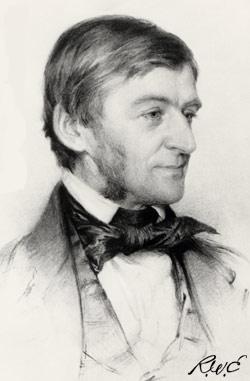
3. The Transcendentalist writer and poet Ralph Waldo Emerson was a huge fan of pie. According to Oliver Wendell Holmes, "Emerson's mode of living was very simple: coffee in the morning, tea in the evening... but always pie at breakfast" (Holmes 362). Once, he was preparing to eat his morning meal with some acquaintances and offered them each in turn a large wedge of pie. When each one declined, Emerson said, in complete frustration, "But, Mr. So-and-so, what is pie for?" (Holmes 269). I'm with you, Emereson. Pie for breakfast each morning does sound divine.
| Ralph Waldo Emerson, Pie Lover |
.14 Not to be outdone, Jane Austen was also a pie devotee. The British author once wrote, "Good apple pies are a considerable part of our domestic happiness." (Schulz 13).
I'm quite hungry now, after all this talk of pie, and I wasn't lucky enough to have pie for breakfast. Pie for lunch sounds divine as well!
Holmes, Oliver Wendell. American Men of Letters: Ralph Waldo Emerson. Boston, MA: Houghton Mifflin Company, 1886. eBook.
http://commons.wikimedia.org/wiki/File:Baked_stargazy_pie.jpg
http://commons.wikimedia.org/wiki/File:Humble_Pie_1974.JPG
http://commons.wikimedia.org/wiki/File:RWEmerson2.jpg
http://www.greatbritishkitchen.co.uk/recipebook/index.php?option=com_rapidrecipe&page=viewrecipe&recipe_id=1015
Star. (2012). In Brewer's dictionary of phrase and fable. Retrieved from http://search.credoreference.com/content/entry/brewerphrase/star/0
Schulz, Phillip Stephen. As American as Apple Pie. New York, NY: Simon and Schuster, 1990. Print.
Soukhanov, Anne, ed. Word Mysteries and Histories: From Quiche to Humble Pie. Boston, MA: Houghton Mifflin Company, 1986. Print.
Thursday, July 25, 2013
This Book is Grrreat!!
We have recently acquired The Great American Cereal Book: How Breakfast Got Its Crunch by Marty Gitlin and Topher Ellis and have since been delighting in cereal nostalgia! Cereal was originally made with laxative properties, but turned towards marketing to children following WWII. Presweetened cereals made their appearance on television, with the help of cartoon characters and popular sitcoms, during the late 1940s through the 1960s. Health-conscious cereals made a return during the 1970s, and both types of cereals now live harmoniously on our grocery store shelves today.
- Surprize – Created by Kellogg’s, this cereal hit the shelves in 1957, but the date in which it was taken off the shelves is unknown. It was known as the “first brown-rice flaked cereal” (168).
- Caramel Puffs – This cereal, created by General Mills, was supposed to be a variation of Cocoa Puffs with “caramel-flavored corn nuggets” (108). It was not well-received and lasted a year on the shelves from 1959-1960.
- Wackies – Created by General Mills, this cereal stayed on the shelves from 1965 to 1966. It was composed of “frosted oats and banana-flavored marbits [marshmallow bits] in various shapes” (175).
- Cornados – Created by General Mills, this cereal stayed on the shelves from 1966-1967. It was composed of “cone-shaped corn and rice” (110).
- Ooobopperoos – Created by Nabisco, this cereal stayed on the shelves from 1972-1973. It was composed of “blueberry-flavored cereal” (212).
- Sir Grapefellow – Created by General Mills, this cereal stayed on the shelves from 1972-1975. It was composed of “grape-flavored oat rings with sweet-grape starbits [star-shaped marshmallow bits]” (220).
- Crunchy Loggs – Created by Kellogg’s, this wood-themed cereal stayed on the shelves from 1978-1979. It was composed of “sweetened corn and oat logs” (195).
![]() |
| Ad found in The Times-Dispatch on March 13, 1903 |
![]() |
| Ad found in The Scranton Tribune on September 8, 1902 |
Do you have a favorite cereal from your childhood? Or perhaps you have had the opportunity to try one of these unusually-flavored cereals? We'd love to know!
The Times-Dispatch: http://chroniclingamerica.loc.gov/lccn/sn85038615/1903-03-13/ed-1/seq-3.pdf
The Scranton Tribune: http://chroniclingamerica.loc.gov/lccn/sn84026355/1902-09-08/ed-1/seq-2/